Monday, 21 January 2013

Yet another year!

It seems a long time ago I wrote wishing my readers a happy new year.

Well, it was a long time ago! January 1st, 2012 to be precise. I haven’t posted anything else since.

Mea culpa and all that…

Anyway, happy new year once again.

Things in my life have changed a lot since a year ago.

My mother died in late March, and I’ve had to spend a lot of time sorting out legal stuff – probate, executing the will and preparing to move to the house we inherited in Wales.

Work at Worcester College of Technology got more and more intense, with fewer staff and an increased workload for those of us that remained.

I gave up smoking for six months, started again, gave up again and started again. (Have I counted those right? Stop, start, stop start… yes, I think that’s correct.)

My wife celebrated, if that’s the right word, her sixty-fifth birthday in November.

At about the same time, probate was sorted out. With some money come some options and work became intolerable.

I resigned from Worcester College of Technology in December. At the end of March this year, my wife and I will be moving to Mid Wales for good, after selling the house in Malvern. The plan is to spend six  hours per day writing/editing/rewriting and submitting manuscripts. Add to that some third party editing, some website design and creating interactive educational resources and I’ll be as busy as ever. It’s just that the emphasis will have shifted much more to the writing side.

A few years ago, I wrote a post describing a production-line style of writing, applying standard times and operations for the various phases of fiction production (rewrite, line edit and so on).

It is with a degree of humility (a rare feeling for me, don’t get used to it) that I look back on the confident predictions I made at the start of last year. None of them came to pass. But now, at least, I have enough of a backlog, with the recent addition of a Nano first draft, to implement this industrial approach to the writing process.

Yes, I know I’m looking on the bright side of things. Well. why not? With such a complete change in lifestyle, location and occupation, I have to be excited. Or dead.

In various stages of completion we have:

  • 6 novels
  • 1 novella
  • 5 screenplays
  • 3 anthologies

In later posts I’ll let you know how the production cycle is working out. Right now, I’m finalising exactly how the factory process is to be put into action.

When I’ve worked out the snags and am ready to get into full flow, which should be Monday 28th Jan, one week away, I’ll share the details with you.

Yes, I know you were going to ask for the details,  so I thought I’d save you the embarrassment Smile

Till then, enjoy!

Sunday, 1 January 2012

Another year...

Let me wish all my readers a happy new year. I hope 2012 brings you all you would wish for. I even hope it brings all you wish for other people. I'm guessing that's mainly good things...

Me? Well, I've been busy planning. Ask me what I should be doing on, for example, October 17th at 20:30. Go on, ask!

I'm glad you asked. I should be about 70% through writing a query letter and crafting a synopsis for a novel entitled "Innocent Error".

You see, this is the year I get rid of the backlog.

A less anal person might look at some items in their backlog and delete them. Chalk it up to experience and move on. Fragments (oh, yes, I have many fragments) might, rarely, be slated for completion. More likely, they will be ditched. That first book they wrote will garner a fond smile before being burned. It served its purpose as a training exercise. Now it can be forgotten. This sensible, efficient writer will be focused on the future. They are going to produce one novel and twelve short stories this year, all of which will be rewritten, edited, sent out to beta readers, tweaked, honed and given a final polish before being submitted. All of them. A work, once started, will be completed and sent off.

I salute this efficient, unsentimental, effective writer. I wish them well.

I'm not doing that. Oh, no. I'm going through the entire backlog: rewriting, editing, gaining critiques, honing, polishing...

All of them.

I will start 2013 with no backlog. All my works to date will be out there, fighting for attention and sales. That's five novels, four screenplays and three anthologies of short stories. I can just about finish them all, go through the entire production process, submit them to carefully chosen agents - having regard for location, genre, other clientele and general suitability - and maintain a database of submissions. I should submit the last novel on December 30th, just short of midnight. I can look at the database on 31st December 2012 with a degree of smugness.

A sceptical reader might think - oh, poor dear. He's got writer's block. No new ideas, can't face the blank page anymore.

Not at all. I have plots for two more novels, two screenplays and ideas for about 130 other works stored away. I like to say they're maturing nicely. If past experience is anything to go by (and let's face it, at my age, past experience is frequently all I have to go by) I will generate another twenty or thirty good ideas this year.

Talking of past experience, all my hard-earned knowledge of plans and schedules tells me this plan will last perhaps one week before something happens to throw everything off track. Timetables will go awry, word counts will be hopelessly lacking, I'll have to face change of job, bereavement, moving house and the complete demise of Western society as we know it. Ah well, no change there.

Which is why I've restricted my New Year's resolutions to these three:
  • I will submit two different novels to agents this year
  • I will submit two different screenplays to agents this year
  • I will self-publish one anthology of linked short stories
I like the ambiguity. About fifty percent of theoretical maximum output, and I don't specify which novels, screenplays and anthology. Because I know in one year's time, I'll be writing:
  
"I will start 2014 with no backlog. All my works to date will be out there..."

Until the next time - enjoy!

Wednesday, 26 October 2011

You thought they were dead?

In good olde Britain, many years ago, there was a bunch called the Puritans.

They started out with good intentions; they wanted to strip away all the ritual and flummery from Church services. Good on them, we cry!

But then they got into power. And, big surprise, they didn't stop there. They ended up being extremists. They banned singing, dancing and enjoyment. "You are here to praise God, not to enjoy yourself," some of them might have cried. Then we had the restoration; King Charles I, the Merry Monarch, came back and all was well with the world. The Puritans slunk away into the dark, and all was well.

Aye, and all manner of things would be well. No more puritans. The world would never hear of them again.


Did you think that? No more puritans?

Dumbass!

They are back, and they run our lives - or try to.

Oh sure, they don't step up, bold as brass, and say "We are Puritans, and we will now control your lives!"

If they said that, OK, fair play, they set themselves up as a target to fight against. But no, not these new puritans.

They sneak in, via unnoticed bye-laws. They infiltrate well-meaning special interest groups. They crawl into local government, or perhaps masquerade as innocuous MPs, disguising their true intent until they have a sniff of power. They recruit naive but eloquent speakers on their behalf.

How to spot one?

Their message is always the same: "Thou shalt not..."

I write this as a man, straight, approaching sixty. I eat meat and fornicate with women. I am of middle height, fat (though I prefer the words stocky or robust), don't exercise much, drink alcohol and smoke.

They hate me.

Daily I am exhorted, stridently, to do things for the sake of: the planet, the environment, my neighbours, my society, my friends, information security, the future of mankind (sorry, personkind) and above all, for the sake of people living in places I can't even pronounce.

If I don't comply, I will be shunned, reviled against in general, and probably taxed. My carbon footprint will be held up to appall the doubters; I will be denounced, heaven forfend, as not green.

These new puritans go further. They will dumb-down any TV serial I might enjoy, because it might give offence to vegetarian, one-legged, vertically-challenged, differently-sane one-parent Esquimaux.

Now, to all vegetarian, one-legged, vertically-challenged, differently-sane one-parent Esquimaux out there who are outraged by my life-style choices, I say: get a life.

To the new puritans out there protesting on their behalf I say: leave your life.

To the rest of us I say: be warned. They haven't gone away. The bastards who would stop you living as you wish are still around, and they mean to stop you.

Give them the sign - you know, the one that means they're number one!

Yes, that finger!

Wednesday, 5 October 2011

Reality versus perception

This post has been triggered by the Amanda Knox / Meredith Kercher case.

Now, I don't know the details of the case, so I'm not going to comment on the initial verdict or its overturn in the subsequent appeal. But what has struck me is the opposing views of Amanda Knox.

To much of the American media, she is a heroine, unjustly accused, fighting for a thousand days to clear her name. To most of the rest of the world she is evil, manipulative and a sociopath.

Whatever the truth, she will profit from it, no matter how just or unjust that may be. But why the discrepancy?

Why do the American public view her as a clean cut, pretty, young American girl and therefore innocent, persecuted by depraved and corrupt Italian officialdom? Why do the Brits feel she's slithered out of her conviction because of incompetence on the part of - yes, you've guessed it - corrupt Italian officialdom?

Perceptions. That's why. Most of the world regard the Italian police and judiciary as hopelessly corrupt. Most Italians probably think the same. But that does not make it true. Most Americans regard clean-cut American girls abroad as incapable of being criminals. Doesn't make it true. Some people believe the Moon is made of green cheese, and if it isn't then it's really, really unfair. The Moon doesn't care. It isn't made of cheese and isn't going to change for anyone. It has no motivation to make the change. It is made of rock and dust and it's staying that way.

Reality is what it is, and no matter how you view it, it will remain unchanged.

What about the Observer Effect? I hear you cry. You know, where the act of observing (perceiving) something alters the fundamental nature of the thing being watched.

Deep philosophical point. The effect of bombarding sub-atomic particles with X-rays in order to discern their structure might well change their structure, position, spin, charge or any other properties. True. The act of looking at Amanda Knox as an innocent victim does not make her one.

If a branch falls in the forest and no-one is there to observe, has it fallen?

Duh, yes it has. Does it make a sound? Well, who knows. And, frankly, my dear, I don't give a damn.

So the true role of a PR agent is to change our perception of reality and thus influence our actions with regard to that (apparently) altered reality. Not Public Relations but Permeable Reality.

Cool job!

Thursday, 29 September 2011

The arrogance of youth

o tempora, o mores...

First let me say if you are reading this, are young and not at all arrogant, this doesn't apply to you. But I bet you can recognise several of your friends. Also, if you're reading this, are not so young and very arrogant - well, welcome to the club.

This post has been inspired by a seventeen-year-old recent member of the Goodreads community. This person, who shall remain nameless save to say he goes by a shortened version of Shakespeare's first name, has apparently never encountered the concept of spellchecking. Neither has he discovered the shift key. Punctuation? Never heard of it.

R u stil wiv me? lmao.


That sort of language, in and of itself, is perhaps excusable. Maybe he missed many years of schooling due to some loathsome and socially embarrassing disease. Maybe he has an old keyboard and the shift key doesn't work. Or maybe he has merely fallen into bad and lazy habits while endlessly texting drivel about American Idol.

What is not excusable is that when it was pointed out to him, gently at first, more scathingly later, that in a group devoted to fiction writing and the improvement thereof, it behooved him to use such basic constructs as sentences; that it was impolite to pour out meaningless, illiterate drivel riddled with errors of spelling and syntax; that complete ideas are often possible even in the most difficult of circumstances; why, what was his reaction?

'i wrt how i wrt lol; lmao; its my ideers thast re impotent.'

When it was mentioned that asking a question like 'how do i publish an e book' showed an arrogant reluctance to do even the most basic of research for himself before asking other people to spend their time on him - same response.

A lazy, arrogant youth with, apparently, precious little to be arrogant about. Maybe he thinks he looks like Brad Pitt.

I have to say he is only the third example of such feckless idiocy I have encountered in three years as a Goodreads member. They generally are self-selected out when they realise it's a site devoted to books.

Monday, 26 September 2011

Why planning doesn't matter any more...

Do you like to plan things? I'm not restricting this to plotting before writing; I'm thinking in a wider, life-skill way.

Recent trends in business, industry and politics seem to me to have announced the death-knell of meticulous planning. Governments do whatever tabloid surveys suggest would be popular without working out consequences. Companies plough on with changes to structure and organization without thinking about the effect on quality of provision or the problems such changes will cause.

Oh, of course. Sorry. We don't have problems any more; we have challenges.

I can see several advantages to not having rigid plans for the future.
  • It's impossible to anticipate every eventuality. Your lovely plan may have to be changed or even scrapped very early on
  • Trying to cater for everything that could go wrong will ultimately lead to paralysis
  • Adaptability and flexibility are vital qualities everyone should possess
That doesn't mean you don't plan at all. You make your plans broad in scope, sketchy in detail. They will guide you along the right lines, satisfy the major thrust of your activity, help you stay on track.

While it's true, in military terms, that no plan survives first contact with the enemy, the armed forces still have plans to get them going in the first place. How to get in, what you do when you're there and how to get out; these are vital elements of every military plan. If they continue to plan, even though they know full well the plan is doomed to fail - shouldn't we do likewise?

Otherwise, we would live our lives like some demented character from a self-help book: 'Ready, fire, aim...'

Tuesday, 13 September 2011

Experience not required?

There is a depressing trend, in many organizations in the UK, to put cost ahead of all other criteria when it comes to employing staff.

"Surely not!" I hear you cry. "Unbelievable!"

Believe it. I've seen it happening to a dear friend of mine this year. She is immensely talented, highly qualified, massively experienced, deeply committed and hugely successful at what she does. She also costs quite a bit per hour.

So she's being replaced by a new graduate willing to work for about half the salary. The fact the new graduate will not be legally or even mentally able to do half the things my friend did seems to be irrelevant. The need for these things still exists; that need won't be met unless the organization throws its (metaphorical) hands up in defeat and hires an outside consultant. Who will cost more ultimately than my friend ever did.

It's the underlying messages that worry me. Many employers seem to believe qualifications are more important than experience; that theory accurately reflects reality. This is delusional thinking. Basing decisions on faulty paradigms always leads to disaster.

It's also a subtle form of ageism. Someone with twenty-five years experience in a subject is going to be at least twenty-five years older than someone with no experience in that subject. Let's not forget, young people are willing to work for less than more mature people because they are less convinced of their own worth.

'Intern' is a fancy way of saying 'slave'.

An organization that makes its employment decisions based on cost rather than quality is an organization that is doomed. The demise may be a few years coming, because of the nature of the employment sector it's in, but doom is on its way. The sad thing is, the organization of which I write is only one of many, all of them doing the same thing. I foresee calamitous times ahead for us all.

Remember, you heard it here first.

Thursday, 8 September 2011

Schedule your life

Yesterday, I wrote about the follies of organizing your life with absolutes - like I will write for six hours a day. What do you mean - you didn't read it? Go away and read it now.

Go on. I'll wait right here till you get back.

Done? OK, let's move on. We all agree that shit happens, and it happens all the time; usually it happens to us. So we need to take account of it in any planning or scheduling we do.That means allocating a large chunk of time where we do nothing. Most days, something unexpected will crop up and that time will get filled somehow. If nothing goes wrong, great; we have a couple of hours free time to do anything we like. Read, write, watch a sunset, drink a barrel of ale.

Here, in no particular order, are some other things to remember when creating a schedule.

  • Avoid averages. We may work 48 weeks/year, 37.5 hours/week, which equals 1800 hours, or an average of 5 hours/day. However, we don't work five hours/day on the days we go to work.What with actual work, and travelling to and from, most people have nine hours or more taken out of their life on workdays. Similarly, we don't work any hours at weekends or during holidays - at least not for our job. We may work for ourselves, but that's a different matter.
  • The converse of 'avoid averages' is 'be specific'. So do it. Be specific. Your schedule should reflect reality. If you leave for work at 7:55AM Monday-Thursday, that's what should be in the schedule.
  • Keep it real. If you've always had your evening meal at 19:00 hours, keep it like that. Why change anything you don't need to? You'll only upset yourself and those around you.
  • Avoid ideals. By that, I don't mean become a person of dubious morals. I mean you may approach an ideal state of being occasionally, but normally you're like the rest of us: flawed, weak and undependable. It may be your ideal to run half marathons before breakfast, avoid alcohol and eat a high-fibre five-a-day diet while paying your bills on time and never cheating the Government. It may be your ideal, but if you try and live it, you'll end up mugging some poor sod for his bacon sandwich.You know yourself. You know you'll never do what you'd like to do. You can, however, do something towards it.
  • Think small. Never mind exercising for two hours a day. Start with fifteen minutes a few times a week.
  • Symmetry is great. Don't distort your random life trying to achieve it.
 I'll share my schedule with you now, and explain why I chose various options. It's a good schedule. It's good because it can be done and I can stick to it.

Mostly.


But if all you're doing is creating new stuff for two hours every evening, when does the editing and proofing and so on get done?

Good question. Notice that schedule is weekdays. At weekends, I work for 8 hours on Saturday and 4 hours on Sunday. That's the rewrites, line edits, proofreading and so on. So it's about 24 hours per week in total during term time. During the 13 weeks of holidays, I'm writing or editing for about 40 hours per week.So, in my nice relaxed way, I'm still managing as much time writing per year as I am doing paid work for other people.

Which is nice.

Notice the work/life balance? I'm in bed for eight hours a day, working for eight, and having eight to myself - writing, eating, exercising, chilling out. Better than a busy-busy-busy timetable, don't you think?

Wednesday, 7 September 2011

Think small

Traditionally, motivational gurus and self-help enthusiasts encourage us to think big. 'Dream on a grand scale' they advise us, and 'reach for the stars'. They pour scorn on the old advice not to set your sights too high.

But are they right? If you set high standards and challenging targets, do you risk overwhelming yourself before you even get started?

I think so. Let's consider a typical person developing a new daily schedule to fit in all the things they want to do, in addition to all the things they need to do. Let's even assume they have the luxury that all these things actually fit into a standard twenty-four hour day. The alternative involves emigration to a planet with a slower rotational period.


Wow! I have an entire four hours a day free. Well, I've long been meaning to start an exercise programme that'll convert me from a couch potato to an Olympic athlete in two years, so that's two hours a day. That leaves two hours per day for writing.

Two hours? That's not very much, is it? You won't be producing two books, two screenplays and twelve short stories a year just by writing two hours a day, will you?  

You're right. OK, let's see if we can't economise a bit. I can cycle to work, which is as quick as using the car and takes care of the exercise as well. And no-one really needs to sleep for eight hours; six would be fine.That gives us six hours a day free to write.

That's more like it. Six hours a day is about 6000 words. Assume we take Christmas day, New Year's day, two birthdays and the summer solstice off, that's 360 days a year times 6000 equals 2.1 million words. Also assume that you have to write about 360,000 words to produce a finished standard novel, 100,000 for a finished screenplay and about half a million for the short stories, blogs and everything else: that means we can produce our two books, two screenplays, twelve short stories, our weekly blog and still have time for our new mammoth epic fantasy series, one giant volume per year!  Sorted!

Great. I'll just produce the daily schedule now...


Yeah, right. I'm sure many of us have devised schedules like that. I know I have.

Guess what?

It won't work. Ever. Oh, you might be able to stick to it for a few days, with a Herculean effort of willpower, but it's unsustainable for medium or long periods. Worse, it will leave you with a learned aversion to cycling and writing which may last for the rest of your life.

So what's the matter with the schedule? 

Let's take a typical day. It's winter. You really want to leap out of bed at five to write for a couple of hours, don't you? It's cold and dark and wet outside, and it's not too sparkling inside. But no, you do it. Well done you! Except it won't be two hours writing, because it takes a small but measurable length of time to get up, get dressed and switch on the PC. So, it's about 1 hour 50 minutes. Already you are ten minutes adrift.

You can wash, dress, cook and eat your breakfast in an hour, so that's OK. You pull on the wet weather gear and cycle off to work. In the rain, into the headwind; with the lorries throwing icy, muddy spray in your face as they thunder past with an inch to spare.

You get to work. It's chaos. Network systems have failed and major new orders have to be filled. You have to work through your lunch break and stay until six in the evening to get things done. Cycle home, picking up a puncture on the way.

Now it's official. You're knackered. You need to eat, your wife is getting dressed up, there's a bill to pay and already it's way past seven. The upstairs tap is dripping, your better half expects you to go out with her to that party you were told about a month ago and you're getting a stinking cold.

Looks like there'll be no writing tonight, unless you stay up till three in the morning. If you do that, you'll have two hours sleep before it starts all over again. Your wife wants to snuggle in bed and if you refuse yet again, you'll end up with pneumonia, divorced and sacked because you keep falling asleep at work.

I know, because I've been down that route, if not all the way.

Next time, I'll share how I now produce a schedule that has a good chance of working, but for now, remember this: shit happens. In fact, shit happens daily.

You need to have periods of time that are actually left free to accomodate these unexpected little crises. You need to allow time for snuggling with your nearest and dearest. You need time to read and watch films and TV dramas to analyse how other writers handle things well (or badly). You need to get enough sleep.

Oh, and two hours writing a day? That's what Stephen King does, and he seems to have produced a fair amount over the years.

Wednesday, 31 August 2011

Motivation - where does it go?

Aaahhh yes, motivation: that topic beloved of self-helpers and psycho-babblers everywhere.

What, you may ask yourself, can I possibly write about motivation that many people before haven't already done a thousand times over?

Good question.

Well, I can give you my own, unique perspective on motivation - that blend of experience and character that I, and I alone, can bring to bear on this subject.

Fair enough, but before we do that, let's all be sure we're talking about the same thing:

Motivation (noun): The psychological feature that arouses an organism to action toward a desired goal; the reason for the action; that which gives purpose and direction to behaviour.

OK. How many times have you heard someone complain they just don't have the motivation to do something? Ten? A hundred? Yeah, right. Several thousand times minimum. And it isn't at all surprising.

Shall I dispel this myth of motivation for all time? Shall I? You really want me to?  OK.

Motivation is a myth. There ain't no such thing.

Look, there are two categories of actions in our world. There are things you have to do, and there are things you want to do.

If you have to do something, motivation doesn't apply. You have to eat. If you don't, you die. No motivation needed there, surely. You have to die. It's unavoidable. Motivation doesn't apply. You have to pay your taxes - if you don't you go to jail.

Ah, OK, there might be a motivation issue. You have two options - pay tax or go to jail. Which would you rather do? If you'd rather go to jail, don't pay your taxes. Sorted. Where is the motivation problem?

All things involve want. When it comes to writing, people say they lack the motivation to edit their works. No they don't. They would just rather do something else than submit a finished novel. If they wanted to submit the novel badly enough, they would do the editing. Motivation not necessary.

Whenever you hear or read the word motivation, replace it with desire or want. If you want to send off your novel, you'll do what it takes. If you'd rather lie on the beach working on your tan - then for goodness sake, lie on the damn beach. Who cares? The world won't end because your novel never got published. The only person who really gives a damn is you. Do it or don't do it.

But if you don't do it, please don't whine about how guilty you feel, or how you lacked motivation. Just be honest. Something else was more appealing. No guilt, no problem with self-image or fear of success or procrastination. You didn't edit because you didn't want to.

End of story.

Friday, 5 August 2011

Muddy waters - suitable for bottom feeders

This is a comment I've just left on The Write Agenda (TWA) website.

What, so all these well-respected literary figures and organizations are engaged in smear and hate campaigns against the rip-off guys and the vanity publishers? Hard to believe. I quote from nielsenhayden.com - April 19th this year:

"Word to the wise: a new outfit calling itself The Write Agenda has been taking potshots at Victoria Strauss, Ann Crispin, our own Jim Macdonald, Absolute Write, Writer Beware, Preditors and Editors, SFWA, Atlanta Nights, and other entities that give newbie writers helpful information about the scams and nogoodniks that prey on them."

So Preditors and Editors and the Science Fiction Writers of America - organizations that are legendary for the impartial, disinterested and unstinting help they give to authors, would-be authors and newcomers - are biased and inaccurate when they adversely comment about Publish America and Author House?

I don't think so.

The fact that the people behind The Write Agenda choose to remain anonymous is enough to convince me this site is an attempt by a combine of sharks to muddy the waters enough they can still continue feeding off their innocent, gullible and needy prey.

This comment posted at 12:29 BST, August 5th 2011. Let's see how long it remains up here and what response it gets.


I've personal experience of some of the authors and organizations TWA is attacking. I've found them, without exception, to be thoughtful, honest, helpful and impartial. They have not attempted to charge me fees or rip me off in any way. They have not attempted to sell me anything.

TWA haven't attempted to sell me anything either. They have, however, attempted to dissuade me, with one star reviews, from purchasing the books of several authors whose work I admire.

They gave one star to a collaborative anthology called Menage-a-20. I'm one of the authors in that anthology. My work is far better than one star. All the authors in there are better than one star. Many of them have in the past attacked Publish America and Author House for their dubious practices.

Coincidence they get one star?

Probably not.

And before you say that reviews are a matter of personal taste, I'd like to point out a fact: there are thirty stories in Menage. They encompass a wide variety of styles, themes and genres. Surely they can't all offend the reviewer's tastes?

But don't take my word for the quality of the stories. Download the anthology. Check it out for yourself. It's free. Then check out the reputation of the authors in the anthology.

Decide for yourself who you'd rather believe.

Monday, 17 January 2011

What is horror?

How would I define a work of horror?

I've taken part in a few, and read or heard many more, discussions on this subject. None of them have precisely expressed what I think makes a horror story. So here is my opinion, for what it's worth. 

For starters, there is no one definition of horror.

Oh, that's really helpful, isn't it?

Yes, but there's more.

Many people have said that if an author intends to scare the reader, that makes the work Horror. More have said if the material scares the reader, the work is Horror.

If that were the case, The Rise and Fall of the Third Reich by William L Shirer would be a masterpiece of surreal horror, set in a society like ours.

Oh, no, wait, that actually happened, didn't it?

No, horror, as I define it, is a work of fiction. And horrific fiction quite happily divides into three types.

Type One

Works set in our world, as we know it, with few, if any, changes. Examples might be The Silence of the Lambs or The Girl Next Door. Now, to me, while horrific, these are not works of Horror. You might call them thrillers, or suspense, or anything else you like, but not Horror. I class these as books about things that do happen. There are cannibals, serial killers and neighbourly torture clubs.

Type Two

If Type One is things that do happen, then Type Two is things that could happen, given a few changes.  Aliens conquer the world. Crazed military scientist unleashes a Doomsday virus (or it escapes). Neural networks become self-aware. Consider The Puppetmasters or Prey. Again, to me, not Horror. Call it action sci-fi, or speculative fiction.

So what does that leave?

Type Three

Things that could never happen. I'm really, really sorry, folks. There are no vampires, werewolves, ghosts, demons, dragons, djinns or zombies. It's a great shame, 'cos I love them too. But they aren't real. Never could be, never will be.

That doesn't stop us writing about them. This, to me, is Horror. Supernatural, playing with death and beyond.

There is a caveat here - the action must take place in a world that is recognisably ours, but with nasties added. For example Bag of Bones, Rosemary's Baby and Dracula. If it takes place on another world, it's probably fantasy. If there is a large element of magic used routinely, it's fantasy.

So there you have it - a story about something that could never exist, added into our world, and scaring the crap out of us, because we've suspended belief and accepted that there are vampires and evil deities resurrected from the dawn of time.

Now that's proper Horror.

Monday, 3 January 2011

This editing year - 1

It seems like a long time ago I last wrote about editing. OK, it was a long time ago. Must have been June last year. Then I advised myself and you, constant readers, to make a spreadsheet of beta-readers' comments.

'OK, did that, now what?' you cry.

I went through the book in question, adding notes to the manuscript (Word: Insert: Comment) in all the places my readers had found something to remark on. Plus, I added my own comments here and there - pithy little notes to myself like 'Move this bit six months forward' or 'Add some action here - perhaps flashback'. Most of the time I read the book with great pleasure, often remarking 'Oh! Great writing here.' Then, with regret, I added a note: 'Flowery - rewrite.'

The entire process took about four hours - remember, this is a standard-sized novel. (Well, actually it's currently some 57K words, so needs fleshing out here and there.)

Next comes the tricky bit. Going through the manuscript a second time, when I come to a note (highlighted in yellow on my system), I read it.

Then I do it.

For example, the words 'Chapter One' had a note attached. It read 'Add prologue'. When I'd got over the shock of having to make a change so early in the book, I got on with it.

The tricky bit is writing a prologue in the same style and tone as the rest of the book. Remember, I wrote this manuscript about ten months ago. The person writing this prologue (me) is not the same person who wrote Chapter One (me-in-the-past).

Having written the prologue, I deleted the note and moved on the the next one. Read-do-delete note.  And so on...


Some of changes require great attention to detail. Moving chunks around in time has a knock-on effect on many other sections of the book. It may also require additional research. What time is sunrise in mid-April in Mid-Wales? What is the weather like generally? Then there are questions like 'If this happens in April and not October, what effect does that have on characters X, Y and Z?'

With flashbacks, it's the same. What was my protagonist supposed to have been doing three years ago? If I have him in action in East Africa, do I say somewhere else that he was in Afghanistan at the time?

This has pointed out some useful tips to bear in mind for future novels. One is the importance of a detailed timeline and back-story for all the characters. I thought I'd done that with this manuscript, but I was wrong. Yes, I'd itemised significant events - date, time, place, summary - but what about the rest? What about that vast collection of apparently insignificant events and activities that form the great bulk of everyones' lives? I didn't have them.

I'm not saying write a day-by-day diary for each character:

Fred, January 3rd, 1989. Got up 06:00, had toast for breakfast. Still staying at 2437 Pacific Heights Boulevard. Broke a vase this morning. Good bowel movement at 0746. The Presidential assassination was postponed again. It's raining. 

That would be ridiculous. But a note like 'Jan 89, Fred in California. Did not assassinate the President. Pete in East Africa, killing Chinese sponsored guerrillas. Feb 89 Fred and Pete back at base. Training. Mar 89...' would have been helpful.

When I've finished the big - the macroscopic if you like - edits, I'll be reading and re-reading the manuscript looking for inconsistencies. Then I'll be delving into the minutiae of the language itself. I'll cover these topics later. 

Until then - enjoy!

Sunday, 2 January 2011

Dark and Secret Writes: Hello, 2011

Dark and Secret Writes: Hello, 2011: "So, a year has come and gone, not with a bang but with a whimper. It seems to have passed in a haze of work, more work, pressure and not eno..."

Hello, 2011

So, a year has come and gone, not with a bang but with a whimper. It seems to have passed in a haze of work, more work, pressure and not enough sleep. (Of course, that could be a function of alcohol and declining cerebral function due to age.) I enjoyed writing during the last twelve months, and, looking back, I did actually manage to produce quite a volume of work - several full length first drafts of novels, a few film scripts, multiple short stories.

That's the good news. The bad news is those works now sit on various hard drives and memory sticks leering at me; they issue the taunting cry - 'Go on, scribbler. Edit us - if you dare.'

Well, I dare. I can't resist a challenge like that. Am I a man or a mouse?

Now, where did that cheese go?

Who will win? Me or approx. 3,200 pages of manuscripts? Only time will tell. The pity is, I have at least four projects I want to start this year, but I think they're going to have to sit on a  shelf somewhere in the subconscious becoming mouldy. Or perhaps maturing like fine wines and cheeses.

OK, I've looked back and there's no one creeping up behind me with malicious intent and clutching a sharp object. Now, let's look forward.

There is no light at the end of the tunnel. This is good, because it means there's no one up ahead with a torch bringing me more work. So, ignoring the average four hours every day I spend earning money to pay the bills, and the six hours a day I spend sleeping, and the two hours a day eating, washing, dressing and the like, it means all the rest can be devoted to writing and reading.

So editing it is. Beta readers (yes, you know who you are. Don't hide at the back. There is no escape,) prepare to be deluged with manuscripts over the next few months.

A word on some changes to the format of this blog. I've joined the Amazon affiliate program, so when I review books, if you click on the link you can go straight to Amazon and buy them. Yes, I will receive a commission if you do that, but believe me when I say I will only recommend books I have actually read and enjoyed. If I read a book and dislike it, I'll make that fact clear in the review. I may have lousy taste, but at least I'm consistent.

Finally, may I wish all readers a happy and fulfilling year. I hope you all enjoy yourself as much as I hope to in the next twelve months.

Saturday, 24 July 2010

Review: Author Jack Ketchum


Hi all!

I've spent a happy few hours reading two books by Jack Ketchum, an author I'd heard much about but never read before.

The books are: Off Season and The Girl Next Door. Both are horror. Neither are for the faint of heart or weak of stomach. By the way, the version of Off Season is not the neutered one that Ballantine Books produced in the 1980s but the revised and partially recovered one that Ketchum produced much later. So if you've read the earlier version (apparently) the later one is much, much nastier.

Unlike Twilight, which I guess most people have read by now, Ketchum might be a new name. I suppose not many have read his works. So I will try very hard to avoid spoilers.

Off Season


This is certainly one of the goriest, most violent works I have ever read. And yet, none of the gore and violence is gratuitous. It's there because it needs to be. Written in 3rd person limited POV, that shifts often (sometimes confusingly), it's a story that offers scant rays of hope and goodness. The predominant feeling is bleak, savage and dark. From a kick-ass start, it maintains a fast-paced writing style, flowing natural dialogue, good characterization, frequent dizzying blows to our expectations throughout, and ends in a chilling and thrilling climax. This book kept me going non-stop. It gives several nods to other icons of horror such as Romero's Night of the Living Dead, and is similar in style, perhaps, to some of James Herbert's more misanthropic works, but its style - I have come to discover - is uniquely Ketchum's own.

I give it an unhesitating 4 stars.

The Girl Next Door


This is in many ways totally diferent to Off Season. We start with an idyllic country scene, young boy in the 1950's playing in a stream, hunting crayfish. Reminiscent of Stephen King in IT.

Told throughout from the point of view of this twelve-year-old, the story takes us through a gradually intensifying maelstrom of horror, made much worse by the sheer prosaicness of the setting. We join in the creeping paralysis and helplessness that besets our protagonist; unwilling yet fascinated voyeurs with him in the flow of events. Reminiscent perhaps of A Simple Plan in its portrayal of the banality and lack of imagination shown by evil.

This one disturbed me more, because it could happen to the girl next door (if there were a girl next door).

Another 4 stars.

Similarities


Neither book has the slightest trace of the supernatural or paranormal in it. Both portray, unflinchingly, the evil that man can do to fellow man.

But the greatest similarity is this: both books depict creatures of human shape, human DNA, human ancestry that walk among us, yet are stranger and more alien than the amoeba. Human they look, but they do not share anything in common with us apart from physical shape - no emotion, no compassion, no fellow feeling. They aren't humane beings, and they barely deserve the title of human beings.

All done without recourse to magic, soul-stealing or any other typical mechanism of much horror fare.

These are both books I'll read again. And probably again.

Tuesday, 20 July 2010

Book Review - Twilight by Stephenie Meyer

OK, I was the last person on the planet to read Twilight. I hadn't read any of the other three books in the Edward/Bella series. I haven't seen the films, or even trailers for the films.

How? Just lucky, I guess.

All I knew about Twilight was that young girls raved over it, anyone over the age of thirty hated it, those blessed (or cursed) with even minimal amounts of testosterone became nauseous in its presence, and vampire afficionados spat garlic and holy water when any mention was made of sparkly vampires.

So, last weekend, since my daughter has the complete set, I read Twilight with a relatively open mind.

Possible spoilers
Let me start on a positive note. I liked Stephenie Meyer's style of writing - fast, easy, page-turning stuff. But then I also like Dan Brown's writing style for the same reasons. And James Patterson. All three have accessible, smooth prose and, generally speaking, fairly natural and believable dialogue.

Back to Stephenie.

So, I liked the style. I'm afraid that's almost it for the good points.

Now for the rest.

Content
Our main character is a teenage girl (Bella). Shallow, self-obsessed and totally absorbed in trivia. Never mind global famine or war in Afghanistan. She worries about what her new friends will think of her, and does that green go with her eyes.

Oh, and she falls like so totally in love with a vampire in the space of two weeks or so.

This vampire has nothing going for him except for being inhumanly beautiful, amazingly fast, unbelievably strong, rich and, presumably, never belching or farting. Well, he doesn't eat, does he? Oh, and he saves her life three times.

See? The girl is shallow, like I said. Nothing about his personality, mind, world view or plans for the future. In fact, all the characters are shallow, veering from furious to placid in the space of two sentences - which is always the sign of poor characterization. Real people, and real vampires, hold grudges. They harbour festering resentments. They are slow to change their opinions. Not in teen-girl world, obviously.

No, wait - Edward Vampire is a tortured soul. We know he's tortured, because both he and the author tell us so, constantly. He is in torment, torn between killing the annoying whiny teenager and falling in love with her. He writhes on a knife edge. He oscillates between love and thirst.

Hmmm. Vampires aren't supposed to have a soul, are they?

Most of the vampires in this book have the same moral dilemma. Humans - frail, slow, blundering, short-lived, pathetic - friends or food? Social circle or herd? No wonder people, including our heroine, want to become vampires. Where's the downside?

The vampires - yes, plural. There is a family of these demi-gods going to school with our heroine. This school is set in Washington State. The cloudiest, wettest, most cloud-bound, fog-shrouded part of Washington State. Echoes of Thirty Days of Night.

Why there?

Because our vampires sparkle in the sunlight. It's the place in the USA with the least amount of sunlight per year. The author explains this sparkling as a mechanism to entice their prey closer.

OK, you can catch fish with something shiny. So if their prey (us, remember?) has the IQ of a mackerel, that's plausible. Oh, wait, teenage girls - yes, fair enough.

These vampires also play baseball. Score one for irony. No problem there.

Oh, and they don't hunt humans any more, because they've all sworn to be good vampires. Sometimes they slip, but not often. Well, yes... I suppose I could just about accept that.

When Bella first thinks Edward is a vampire, and then has it confirmed, her reaction is: 'OK, yeah, so, like nobody's perfect, yah? Look how handsome he is.' Where was the emotional trauma about falling in love with a blood-sucking creature of the night? An undead creature of limitless evil? Oh, sorry, I forgot, these are good vampires. They don't even have bad breath.

The trouble with the book, is that in five hundred pages, nothing much actually happens.

She falls in love, he saves her life, but it's all negligible in terms of visceral action or excitement. Even when a rival clan of 'bad' vampires hunts her, we have no real action. There is a hunt, the excitement builds, she is separated from her vamp protectors, she sacrifices herself for the sake of others. Yes! Action at last!

Er, sadly, no. The climax of the book, from my point of view, is totally missed because our protagonist passes out before most of the action occurs. I felt cheated.

And, if I had to read one more occurrence of ' crooked grin', 'sculpted chest', 'burning eyes' or 'compelling gaze' I was going to vomit.

The biggest problem of all?

Plot structure. There isn't one. There is no nemesis. A baddie is brought in 75% through the book, but he's an incidental plot mechanism enabling the author to further elaborate on the implausibly sudden, unbelievably intense love of girl and vamp. You can discount the Indian boy who also wants Bella, and is a werewolf, because he won't be revealed until Book Two or Three. Because there is no nemesis, we can have no major action. It's all Act One - set up stuff.

Of course, for commercial reasons, that may have been the intention all along. How many people bought the book only to find that, in order to gain satisfaction, they had to buy two or three more books afterwards?

So, my verdict?

If you're a teenage girl worried about surface appearances, peer pressure, the allure of 'bad boys' and very little else - 5 stars.

If you belong to the real human race - 2 stars.

But I do think that Stephenie identified and hit her target market perfectly. I have nothing but admiration for that. She can write well. She just needs a decent plot and some believable characters to bring out the best in her.

Thursday, 15 July 2010

Software and aids for writing

Well, after another massive hiatus, almost fifteen weeks this time, service is resumed.

This post was inspired by a thread, of similar name, in the On Fiction Writing forum on Goodreads. Since it first appeared, I've spent a few hours trying out some of the software mentioned there, so you, Constant Readers, don't have to. Here are a few things I've discovered.

The non-electronic route

I still use some methods for planning and writing that don't (gasp, shock horror) depend on a steady supply of electricity. For example:
  • Plot outline - written, pencil, A4 writing pad
  • Scene outlines - 3 inch X 4 inch index cards, arranged in order
  • Character bio - pencil, A4 pad
  • Timeline - as above
I have even, when separated from PC or laptop, used A4 pads to actually write stuff - you know, the actual prose. Yes, it can still be done without a keyboard or an i-Pad.

In fact, most of my best stories come from just lying in the sun, bottle of beer to hand, writing stuff with a pencil. No worries about extension leads, glare on screens or any of that hi-tech nonsense.

But, since you have, at some point, to produce it electronically for printing or emailing to potential buyers, the sooner you start the digital process the better, I suppose.

The Electronic Route

Well, for research, obviously.

But also...

As some of you may have read before, I tend to write using MS Word 2000. I use a set of templates from the BBC Writers Room, ScriptSmart, which allow me to produce either novels or screenplays, American or British, without having to worry about word counts, font, paragraph format, scene breaks, slug lines and the like - the templates take care of all of that for me.

However, ScriptSmart for the novel or short story seems to have disappeared now, leaving only the screenplay versions. More worryingly, with later versions of Word in Office 2003 or Office 2007, the templates cause the document to lock up after perhaps twenty pages, leaving you unable to add any more. You either have to cut and paste into a new document or start another document for the rest of the story. So these templates are becoming less useful as time goes on.

You could of course create your own templates to do the same thing, from within whatever version of Office you have, but that requires a degree of specialist knowledge, and I'm trying to be broad based here.

I also use Excel spreadsheets to keep track of comments that critiquers use - aligning comments and suggestions with the particular scenes they refer to, so I can see at a glance who's said what about something.

So that's Microsoft Office.

Many people swear by Open Office and indeed, I have an installation of that on a USB memory stick, just in case I'm ever stuck somewhere with a PC and no MS Office in sight. It has perfectly good word processing and spreadsheet software, can import and export from and to all versions of MS Office, and can save things as PDF, which my version of MS Office can't. I could just as easily use Open Office as MS Office for routine stuff like writing. It even has a feature akin to the 'Track Changes' feature of Word, which would allow me to edit other people's stuff, or accept and reject changes that others have made to my works. It's called 'Changes' in Open Office.

But what about specialist software designed especially for novelists and scriptwriters?

OK, I'll discuss some here, but I will focus on Open Source software - for 'Open Source' read 'free'.

Write or Die

Write or Die is a program (install the desktop version in case your Internet connection goes down) that gives you a text editor. You set yourself a challenge, say 500 words in 15 minutes. Begin writing. If you haven't touched the keyboard for 15 seconds, pondering the exact word to use to show subtle nuance, the screen starts turning pink. You have perhaps 10 more seconds before the program plays a loud, really annoying sound. You have failed the challenge. If you don't complete your 500 words in 15 minutes, you get an even louder, even more annoying piece of music. If, on the other hand, you succeed, you get a nice little fanfare.

The point of this application is that it forces you to write. It's for producing first drafts, where, as we all know, the object is to slap your story down as fast as possible and to hell with the errors, repetitions and generally crap standard of writing. WoD can even be configured to disable the backspace key. It's an aide to productivity.

The Internet version, browser based, is free. The desktop version costs $10. I have found it has increased my output from 1000 words per hour to 1500 words per hour. No time for daydreams, or to roll a cigarette. Write or Die!

Drawbacks - yes. Produces text (.txt) output only. You can append your output to a text file, but at some point, you have to copy and paste to another processor to add format, font, italics and so on. But very good for its limited purpose - to get you to produce.

WordWeb

WordWeb is marvellous. When it's running in the background (the default is to have it start on PC startup), if you highlight a word in a document or a text file or a browser, and Ctrl-Right Click, it will tell you the meaning of the word, give you synonyms, types, adjectives, nouns, similar words and so on.
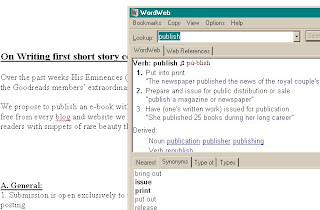


WordWeb is free.

Rough Draft

Another Open Source program. I've played with this and found a use for it.

When editing your own stuff, it would be quite handy if you could just scribble notes in the margins. Rough Draft allows you to do that. It will open up all sorts of Word Documents, Excel Spreadsheets, stuff from MS-Works (if that isn't a contradiction in terms), Rich text and ordinary text files, even Word Perfect Files. You can read them, and make notes in the margin. The notes are saved as an associated text file. It will work with, and format correctly, prose (stories, novels), screenplays and stage and radio plays. When you reopen the story, the notes are still there. Handy for research pointers and so on.

But, it will only save files as rich text (.rtf). OK, as a novelist, that's fine. You will have to eventually put the finished product into Word or equivalent for final formatting and error checking anyway. Very good for editing.
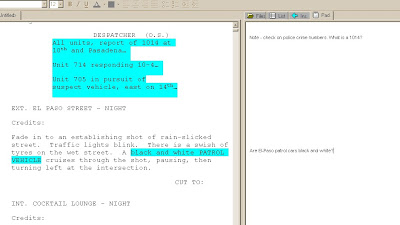


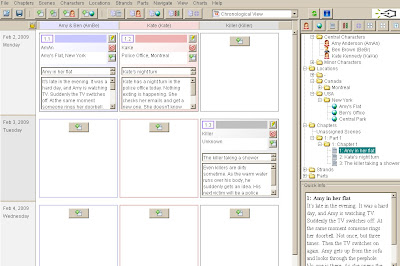
StoryBook

Remember what I said at the very beginning - about index cards and A4 pads and the like for research and outlines and characters and so on?

Well, Storybook does all that. You can create characters, locations, plot strands for each major character, assign a timeline, then just drag and drop your characters and locations into scenes, write scene dialogue and prose, assign scenes to chapters or acts...

It looks to be a very good, and free, tool for creating outlines and plot structures. It might also cut out those embarrassing errors when you've got the same character doing two things simultaneously a hundred miles apart...

But all this is saved in a proprietary format. So you'll need the application on all the other computers you use to be able to use it wherever you are.


So, if you want, try any of those, feel free. I do recommend them.

But I will still often resort to the most flexible, sophisticated method of all.

Brain, paper and pencil.

Next time - reviews - I'm going to start a series of them - new books and old classic books, alternating.

Till then - enjoy!

Monday, 22 March 2010

Back to the editing

Hi all.

After yet another enforced absence (pressure of work, feeble excuse, I know) I'm back, to continue the description of the editing process.

Last time (and it was, believe it or not about ten weeks ago,) we discussed the panel of readers, their feedback and how to put all the comments into a spreadsheet.

This time, I'm going to look at what we actually do with the spreadsheet.

In other words, how to actually edit.

So, In chapter 1, scene 1, we have reviewer A's comment:


The actual sentence was:

Tightly closed doors seemed to deny welcome or solace.

So that's easily changed, since I agree with the reviewer.

Tightly closed doors denied welcome or solace.

That's quite straight forward, isn't it?

But what about where reviewers say 'You need to add more action in the first ten chapters.'

How does one go about doing that?

Well, ahem, by adding more action and conflict and pace.

In this instance, I have to add to the plot.

I had a coherent plot, but, as with all books, the reality deviates from the plan by quite a margin. So, in order to change the plot and add bits, I have to know what's in the plot now, in terms of theme, motivation, character arc, sub-plots and so on.

That's best done by writing a treatment - in other words, re-analysing the book using the snowflake method.

Which I'll apply to this book and detail in my next post.

Until then, enjoy!

Sunday, 10 January 2010

I've been tagged

I've been tagged (who knew?) by two friends, Sonia Carriere and Anna Walls so I suppose I'd better answer the questions and then tag three more unfortunate bloggers :) Be sure to visit their blogs as well for a good read.

1. What's the last thing you wrote? What's the first thing you wrote that you still have?
The most recent thing I've finished is a science-fiction novel called 'Distress Call', which I partly wrote for NaNoWriMo and completed at a much more leisurely pace afterwards. I wrote a bunch of stories and novels back in the early 80s and got rid of them all. I only started writing again about 18 months ago, so the oldest thing I have is a screenplay called 'Death Search'.

2. Write poetry?
No, except rhyming doggerel and the occasional haiku.

3. Angsty poetry?

What's angst?

4. Favourite genre of writing?

Science fiction, horror, fantasy, action thrillers. Both to read and write.

5. Most annoying character you've ever created?
'Under Secretary Whitehead, who always reminded me of a surprisingly clever caricature - the toad in human guise.' A direct quote, and partly based on some people I have worked for.

6. Best plot you've ever created?

I think so far, it has to be 'Revival' - a horror/fantasy novel I'm currently editing.

7. Coolest plot twist you've ever created?
In a short story called 'The Return of the Creature'. Love conquers all, even between different species.

8. How often do you get writer's block?
Never. I always stop in the middle of a sentence or a paragraph, so I know what I intended to write when I start again the next day. Once I've written a few words, I'm up and running again. For me, delaying starting anything isn't block, it's inertia.

9. Write fan fiction?
No, though I did create an outline for a two part Doctor Who season finale. It turned out to be amazingly close to the actual season finale, including some of the lines of dialogue. Pure coincidence, as I intended mine for the following season, and I hadn't even submitted it.

10.Do you type or write by hand?
Type. I can't read my own handwriting half the time.

11. Do you save everything you write?
Yes. In several places, just in case.

12. Do you ever go back to an idea after you've abandoned it?
Sometimes I'll revive an idea that failed as e.g. a novella as a screenplay instead, or vice versa.

13. What's your favourite thing you've ever written?
I think that would have to be 'Halifa', but it's still waiting its turn to be edited.

14. What's everyone else's favourite story you've written?
Opinions vary, probably 'Revival'. So far.

15. Ever written romance or angsty teen?
No angsty teens - my characters are like me - old and past it! There are romantic elements in everything I write, 'cos it's a part of life.

16. What's your favourite setting for your characters?
Settings of extreme tension and fear. Where they're threatened by death and spattered with gore at frequent intervals.

17. How many writing projects are you working on now?
I'm editing one novel, and writing two short stories. Also developing ideas for the next bunch of stories/scripts/books.

18. Have you ever won an award for your writing?
Not yet.

19. What are your five favourite words?
"One ring to rule them." Oh, you mean in real life? "Your cheque's in the post."

20. What character have you created that is most like yourself?
Most of the male protagonists are like me to a certain extent. Or perhaps, like me as I'd like to be.

21. Where do you get your ideas for your characters?
Usually, people I know or have known. You know, mannerisms, habits of speaking, things like that. Physical appearance - sometimes, particularly in film scripts, I like to picture who would play the characters when Tarantino makes the film. So then, the character resembles the actor. The alien ones of course are just that - alien.

22. Do you ever write based on your dreams?
No. I do get a lot of ideas for stories when I'm in that happy state between waking and getting up, just quietly dozing, but usually what I dream about makes no sense, even if I wake myself up and write it down immediately.

23. Do you favour happy endings?
Only if they come naturally. Which is rare, since most of my stuff is quite dark and bleak.

24. Are you concerned with spelling and grammar as you write?
I will go back and check from time to time as I write,but a lot will be left untouched until the first sloppy proofread.

25. Does music help you write?
Once I start writing, I become oblivious to anything around me, so I wouldn't even know if music was playing.

26. Quote something you've written. Whatever pops in your head.
'Offbury was a typical English rural market town: pubs packed with young farm-worker types busy getting pissed; streets roamed by semi-feral, semi-naked packs of young girls emitting unbelievable decibel levels; corners and doorways littered with twelve year olds getting wrecked on white cider.'


From 'The Symbiont'.


My three victims tag choices are:


Jaimey Grant


Henry Lara


Gwen McIntyre

Enjoy!