Monday, 17 January 2011

What is horror?

How would I define a work of horror?

I've taken part in a few, and read or heard many more, discussions on this subject. None of them have precisely expressed what I think makes a horror story. So here is my opinion, for what it's worth. 

For starters, there is no one definition of horror.

Oh, that's really helpful, isn't it?

Yes, but there's more.

Many people have said that if an author intends to scare the reader, that makes the work Horror. More have said if the material scares the reader, the work is Horror.

If that were the case, The Rise and Fall of the Third Reich by William L Shirer would be a masterpiece of surreal horror, set in a society like ours.

Oh, no, wait, that actually happened, didn't it?

No, horror, as I define it, is a work of fiction. And horrific fiction quite happily divides into three types.

Type One

Works set in our world, as we know it, with few, if any, changes. Examples might be The Silence of the Lambs or The Girl Next Door. Now, to me, while horrific, these are not works of Horror. You might call them thrillers, or suspense, or anything else you like, but not Horror. I class these as books about things that do happen. There are cannibals, serial killers and neighbourly torture clubs.

Type Two

If Type One is things that do happen, then Type Two is things that could happen, given a few changes.  Aliens conquer the world. Crazed military scientist unleashes a Doomsday virus (or it escapes). Neural networks become self-aware. Consider The Puppetmasters or Prey. Again, to me, not Horror. Call it action sci-fi, or speculative fiction.

So what does that leave?

Type Three

Things that could never happen. I'm really, really sorry, folks. There are no vampires, werewolves, ghosts, demons, dragons, djinns or zombies. It's a great shame, 'cos I love them too. But they aren't real. Never could be, never will be.

That doesn't stop us writing about them. This, to me, is Horror. Supernatural, playing with death and beyond.

There is a caveat here - the action must take place in a world that is recognisably ours, but with nasties added. For example Bag of Bones, Rosemary's Baby and Dracula. If it takes place on another world, it's probably fantasy. If there is a large element of magic used routinely, it's fantasy.

So there you have it - a story about something that could never exist, added into our world, and scaring the crap out of us, because we've suspended belief and accepted that there are vampires and evil deities resurrected from the dawn of time.

Now that's proper Horror.

Monday, 3 January 2011

This editing year - 1

It seems like a long time ago I last wrote about editing. OK, it was a long time ago. Must have been June last year. Then I advised myself and you, constant readers, to make a spreadsheet of beta-readers' comments.

'OK, did that, now what?' you cry.

I went through the book in question, adding notes to the manuscript (Word: Insert: Comment) in all the places my readers had found something to remark on. Plus, I added my own comments here and there - pithy little notes to myself like 'Move this bit six months forward' or 'Add some action here - perhaps flashback'. Most of the time I read the book with great pleasure, often remarking 'Oh! Great writing here.' Then, with regret, I added a note: 'Flowery - rewrite.'

The entire process took about four hours - remember, this is a standard-sized novel. (Well, actually it's currently some 57K words, so needs fleshing out here and there.)

Next comes the tricky bit. Going through the manuscript a second time, when I come to a note (highlighted in yellow on my system), I read it.

Then I do it.

For example, the words 'Chapter One' had a note attached. It read 'Add prologue'. When I'd got over the shock of having to make a change so early in the book, I got on with it.

The tricky bit is writing a prologue in the same style and tone as the rest of the book. Remember, I wrote this manuscript about ten months ago. The person writing this prologue (me) is not the same person who wrote Chapter One (me-in-the-past).

Having written the prologue, I deleted the note and moved on the the next one. Read-do-delete note.  And so on...


Some of changes require great attention to detail. Moving chunks around in time has a knock-on effect on many other sections of the book. It may also require additional research. What time is sunrise in mid-April in Mid-Wales? What is the weather like generally? Then there are questions like 'If this happens in April and not October, what effect does that have on characters X, Y and Z?'

With flashbacks, it's the same. What was my protagonist supposed to have been doing three years ago? If I have him in action in East Africa, do I say somewhere else that he was in Afghanistan at the time?

This has pointed out some useful tips to bear in mind for future novels. One is the importance of a detailed timeline and back-story for all the characters. I thought I'd done that with this manuscript, but I was wrong. Yes, I'd itemised significant events - date, time, place, summary - but what about the rest? What about that vast collection of apparently insignificant events and activities that form the great bulk of everyones' lives? I didn't have them.

I'm not saying write a day-by-day diary for each character:

Fred, January 3rd, 1989. Got up 06:00, had toast for breakfast. Still staying at 2437 Pacific Heights Boulevard. Broke a vase this morning. Good bowel movement at 0746. The Presidential assassination was postponed again. It's raining. 

That would be ridiculous. But a note like 'Jan 89, Fred in California. Did not assassinate the President. Pete in East Africa, killing Chinese sponsored guerrillas. Feb 89 Fred and Pete back at base. Training. Mar 89...' would have been helpful.

When I've finished the big - the macroscopic if you like - edits, I'll be reading and re-reading the manuscript looking for inconsistencies. Then I'll be delving into the minutiae of the language itself. I'll cover these topics later. 

Until then - enjoy!

Sunday, 2 January 2011

Dark and Secret Writes: Hello, 2011

Dark and Secret Writes: Hello, 2011: "So, a year has come and gone, not with a bang but with a whimper. It seems to have passed in a haze of work, more work, pressure and not eno..."

Hello, 2011

So, a year has come and gone, not with a bang but with a whimper. It seems to have passed in a haze of work, more work, pressure and not enough sleep. (Of course, that could be a function of alcohol and declining cerebral function due to age.) I enjoyed writing during the last twelve months, and, looking back, I did actually manage to produce quite a volume of work - several full length first drafts of novels, a few film scripts, multiple short stories.

That's the good news. The bad news is those works now sit on various hard drives and memory sticks leering at me; they issue the taunting cry - 'Go on, scribbler. Edit us - if you dare.'

Well, I dare. I can't resist a challenge like that. Am I a man or a mouse?

Now, where did that cheese go?

Who will win? Me or approx. 3,200 pages of manuscripts? Only time will tell. The pity is, I have at least four projects I want to start this year, but I think they're going to have to sit on a  shelf somewhere in the subconscious becoming mouldy. Or perhaps maturing like fine wines and cheeses.

OK, I've looked back and there's no one creeping up behind me with malicious intent and clutching a sharp object. Now, let's look forward.

There is no light at the end of the tunnel. This is good, because it means there's no one up ahead with a torch bringing me more work. So, ignoring the average four hours every day I spend earning money to pay the bills, and the six hours a day I spend sleeping, and the two hours a day eating, washing, dressing and the like, it means all the rest can be devoted to writing and reading.

So editing it is. Beta readers (yes, you know who you are. Don't hide at the back. There is no escape,) prepare to be deluged with manuscripts over the next few months.

A word on some changes to the format of this blog. I've joined the Amazon affiliate program, so when I review books, if you click on the link you can go straight to Amazon and buy them. Yes, I will receive a commission if you do that, but believe me when I say I will only recommend books I have actually read and enjoyed. If I read a book and dislike it, I'll make that fact clear in the review. I may have lousy taste, but at least I'm consistent.

Finally, may I wish all readers a happy and fulfilling year. I hope you all enjoy yourself as much as I hope to in the next twelve months.

Saturday, 24 July 2010

Review: Author Jack Ketchum


Hi all!

I've spent a happy few hours reading two books by Jack Ketchum, an author I'd heard much about but never read before.

The books are: Off Season and The Girl Next Door. Both are horror. Neither are for the faint of heart or weak of stomach. By the way, the version of Off Season is not the neutered one that Ballantine Books produced in the 1980s but the revised and partially recovered one that Ketchum produced much later. So if you've read the earlier version (apparently) the later one is much, much nastier.

Unlike Twilight, which I guess most people have read by now, Ketchum might be a new name. I suppose not many have read his works. So I will try very hard to avoid spoilers.

Off Season


This is certainly one of the goriest, most violent works I have ever read. And yet, none of the gore and violence is gratuitous. It's there because it needs to be. Written in 3rd person limited POV, that shifts often (sometimes confusingly), it's a story that offers scant rays of hope and goodness. The predominant feeling is bleak, savage and dark. From a kick-ass start, it maintains a fast-paced writing style, flowing natural dialogue, good characterization, frequent dizzying blows to our expectations throughout, and ends in a chilling and thrilling climax. This book kept me going non-stop. It gives several nods to other icons of horror such as Romero's Night of the Living Dead, and is similar in style, perhaps, to some of James Herbert's more misanthropic works, but its style - I have come to discover - is uniquely Ketchum's own.

I give it an unhesitating 4 stars.

The Girl Next Door


This is in many ways totally diferent to Off Season. We start with an idyllic country scene, young boy in the 1950's playing in a stream, hunting crayfish. Reminiscent of Stephen King in IT.

Told throughout from the point of view of this twelve-year-old, the story takes us through a gradually intensifying maelstrom of horror, made much worse by the sheer prosaicness of the setting. We join in the creeping paralysis and helplessness that besets our protagonist; unwilling yet fascinated voyeurs with him in the flow of events. Reminiscent perhaps of A Simple Plan in its portrayal of the banality and lack of imagination shown by evil.

This one disturbed me more, because it could happen to the girl next door (if there were a girl next door).

Another 4 stars.

Similarities


Neither book has the slightest trace of the supernatural or paranormal in it. Both portray, unflinchingly, the evil that man can do to fellow man.

But the greatest similarity is this: both books depict creatures of human shape, human DNA, human ancestry that walk among us, yet are stranger and more alien than the amoeba. Human they look, but they do not share anything in common with us apart from physical shape - no emotion, no compassion, no fellow feeling. They aren't humane beings, and they barely deserve the title of human beings.

All done without recourse to magic, soul-stealing or any other typical mechanism of much horror fare.

These are both books I'll read again. And probably again.

Tuesday, 20 July 2010

Book Review - Twilight by Stephenie Meyer

OK, I was the last person on the planet to read Twilight. I hadn't read any of the other three books in the Edward/Bella series. I haven't seen the films, or even trailers for the films.

How? Just lucky, I guess.

All I knew about Twilight was that young girls raved over it, anyone over the age of thirty hated it, those blessed (or cursed) with even minimal amounts of testosterone became nauseous in its presence, and vampire afficionados spat garlic and holy water when any mention was made of sparkly vampires.

So, last weekend, since my daughter has the complete set, I read Twilight with a relatively open mind.

Possible spoilers
Let me start on a positive note. I liked Stephenie Meyer's style of writing - fast, easy, page-turning stuff. But then I also like Dan Brown's writing style for the same reasons. And James Patterson. All three have accessible, smooth prose and, generally speaking, fairly natural and believable dialogue.

Back to Stephenie.

So, I liked the style. I'm afraid that's almost it for the good points.

Now for the rest.

Content
Our main character is a teenage girl (Bella). Shallow, self-obsessed and totally absorbed in trivia. Never mind global famine or war in Afghanistan. She worries about what her new friends will think of her, and does that green go with her eyes.

Oh, and she falls like so totally in love with a vampire in the space of two weeks or so.

This vampire has nothing going for him except for being inhumanly beautiful, amazingly fast, unbelievably strong, rich and, presumably, never belching or farting. Well, he doesn't eat, does he? Oh, and he saves her life three times.

See? The girl is shallow, like I said. Nothing about his personality, mind, world view or plans for the future. In fact, all the characters are shallow, veering from furious to placid in the space of two sentences - which is always the sign of poor characterization. Real people, and real vampires, hold grudges. They harbour festering resentments. They are slow to change their opinions. Not in teen-girl world, obviously.

No, wait - Edward Vampire is a tortured soul. We know he's tortured, because both he and the author tell us so, constantly. He is in torment, torn between killing the annoying whiny teenager and falling in love with her. He writhes on a knife edge. He oscillates between love and thirst.

Hmmm. Vampires aren't supposed to have a soul, are they?

Most of the vampires in this book have the same moral dilemma. Humans - frail, slow, blundering, short-lived, pathetic - friends or food? Social circle or herd? No wonder people, including our heroine, want to become vampires. Where's the downside?

The vampires - yes, plural. There is a family of these demi-gods going to school with our heroine. This school is set in Washington State. The cloudiest, wettest, most cloud-bound, fog-shrouded part of Washington State. Echoes of Thirty Days of Night.

Why there?

Because our vampires sparkle in the sunlight. It's the place in the USA with the least amount of sunlight per year. The author explains this sparkling as a mechanism to entice their prey closer.

OK, you can catch fish with something shiny. So if their prey (us, remember?) has the IQ of a mackerel, that's plausible. Oh, wait, teenage girls - yes, fair enough.

These vampires also play baseball. Score one for irony. No problem there.

Oh, and they don't hunt humans any more, because they've all sworn to be good vampires. Sometimes they slip, but not often. Well, yes... I suppose I could just about accept that.

When Bella first thinks Edward is a vampire, and then has it confirmed, her reaction is: 'OK, yeah, so, like nobody's perfect, yah? Look how handsome he is.' Where was the emotional trauma about falling in love with a blood-sucking creature of the night? An undead creature of limitless evil? Oh, sorry, I forgot, these are good vampires. They don't even have bad breath.

The trouble with the book, is that in five hundred pages, nothing much actually happens.

She falls in love, he saves her life, but it's all negligible in terms of visceral action or excitement. Even when a rival clan of 'bad' vampires hunts her, we have no real action. There is a hunt, the excitement builds, she is separated from her vamp protectors, she sacrifices herself for the sake of others. Yes! Action at last!

Er, sadly, no. The climax of the book, from my point of view, is totally missed because our protagonist passes out before most of the action occurs. I felt cheated.

And, if I had to read one more occurrence of ' crooked grin', 'sculpted chest', 'burning eyes' or 'compelling gaze' I was going to vomit.

The biggest problem of all?

Plot structure. There isn't one. There is no nemesis. A baddie is brought in 75% through the book, but he's an incidental plot mechanism enabling the author to further elaborate on the implausibly sudden, unbelievably intense love of girl and vamp. You can discount the Indian boy who also wants Bella, and is a werewolf, because he won't be revealed until Book Two or Three. Because there is no nemesis, we can have no major action. It's all Act One - set up stuff.

Of course, for commercial reasons, that may have been the intention all along. How many people bought the book only to find that, in order to gain satisfaction, they had to buy two or three more books afterwards?

So, my verdict?

If you're a teenage girl worried about surface appearances, peer pressure, the allure of 'bad boys' and very little else - 5 stars.

If you belong to the real human race - 2 stars.

But I do think that Stephenie identified and hit her target market perfectly. I have nothing but admiration for that. She can write well. She just needs a decent plot and some believable characters to bring out the best in her.

Thursday, 15 July 2010

Software and aids for writing

Well, after another massive hiatus, almost fifteen weeks this time, service is resumed.

This post was inspired by a thread, of similar name, in the On Fiction Writing forum on Goodreads. Since it first appeared, I've spent a few hours trying out some of the software mentioned there, so you, Constant Readers, don't have to. Here are a few things I've discovered.

The non-electronic route

I still use some methods for planning and writing that don't (gasp, shock horror) depend on a steady supply of electricity. For example:
  • Plot outline - written, pencil, A4 writing pad
  • Scene outlines - 3 inch X 4 inch index cards, arranged in order
  • Character bio - pencil, A4 pad
  • Timeline - as above
I have even, when separated from PC or laptop, used A4 pads to actually write stuff - you know, the actual prose. Yes, it can still be done without a keyboard or an i-Pad.

In fact, most of my best stories come from just lying in the sun, bottle of beer to hand, writing stuff with a pencil. No worries about extension leads, glare on screens or any of that hi-tech nonsense.

But, since you have, at some point, to produce it electronically for printing or emailing to potential buyers, the sooner you start the digital process the better, I suppose.

The Electronic Route

Well, for research, obviously.

But also...

As some of you may have read before, I tend to write using MS Word 2000. I use a set of templates from the BBC Writers Room, ScriptSmart, which allow me to produce either novels or screenplays, American or British, without having to worry about word counts, font, paragraph format, scene breaks, slug lines and the like - the templates take care of all of that for me.

However, ScriptSmart for the novel or short story seems to have disappeared now, leaving only the screenplay versions. More worryingly, with later versions of Word in Office 2003 or Office 2007, the templates cause the document to lock up after perhaps twenty pages, leaving you unable to add any more. You either have to cut and paste into a new document or start another document for the rest of the story. So these templates are becoming less useful as time goes on.

You could of course create your own templates to do the same thing, from within whatever version of Office you have, but that requires a degree of specialist knowledge, and I'm trying to be broad based here.

I also use Excel spreadsheets to keep track of comments that critiquers use - aligning comments and suggestions with the particular scenes they refer to, so I can see at a glance who's said what about something.

So that's Microsoft Office.

Many people swear by Open Office and indeed, I have an installation of that on a USB memory stick, just in case I'm ever stuck somewhere with a PC and no MS Office in sight. It has perfectly good word processing and spreadsheet software, can import and export from and to all versions of MS Office, and can save things as PDF, which my version of MS Office can't. I could just as easily use Open Office as MS Office for routine stuff like writing. It even has a feature akin to the 'Track Changes' feature of Word, which would allow me to edit other people's stuff, or accept and reject changes that others have made to my works. It's called 'Changes' in Open Office.

But what about specialist software designed especially for novelists and scriptwriters?

OK, I'll discuss some here, but I will focus on Open Source software - for 'Open Source' read 'free'.

Write or Die

Write or Die is a program (install the desktop version in case your Internet connection goes down) that gives you a text editor. You set yourself a challenge, say 500 words in 15 minutes. Begin writing. If you haven't touched the keyboard for 15 seconds, pondering the exact word to use to show subtle nuance, the screen starts turning pink. You have perhaps 10 more seconds before the program plays a loud, really annoying sound. You have failed the challenge. If you don't complete your 500 words in 15 minutes, you get an even louder, even more annoying piece of music. If, on the other hand, you succeed, you get a nice little fanfare.

The point of this application is that it forces you to write. It's for producing first drafts, where, as we all know, the object is to slap your story down as fast as possible and to hell with the errors, repetitions and generally crap standard of writing. WoD can even be configured to disable the backspace key. It's an aide to productivity.

The Internet version, browser based, is free. The desktop version costs $10. I have found it has increased my output from 1000 words per hour to 1500 words per hour. No time for daydreams, or to roll a cigarette. Write or Die!

Drawbacks - yes. Produces text (.txt) output only. You can append your output to a text file, but at some point, you have to copy and paste to another processor to add format, font, italics and so on. But very good for its limited purpose - to get you to produce.

WordWeb

WordWeb is marvellous. When it's running in the background (the default is to have it start on PC startup), if you highlight a word in a document or a text file or a browser, and Ctrl-Right Click, it will tell you the meaning of the word, give you synonyms, types, adjectives, nouns, similar words and so on.
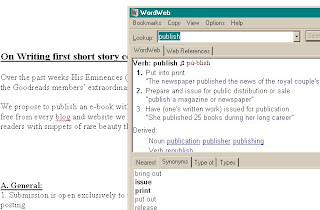


WordWeb is free.

Rough Draft

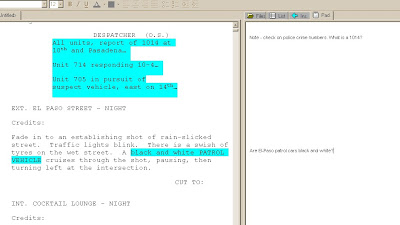
Another Open Source program. I've played with this and found a use for it.

When editing your own stuff, it would be quite handy if you could just scribble notes in the margins. Rough Draft allows you to do that. It will open up all sorts of Word Documents, Excel Spreadsheets, stuff from MS-Works (if that isn't a contradiction in terms), Rich text and ordinary text files, even Word Perfect Files. You can read them, and make notes in the margin. The notes are saved as an associated text file. It will work with, and format correctly, prose (stories, novels), screenplays and stage and radio plays. When you reopen the story, the notes are still there. Handy for research pointers and so on.

But, it will only save files as rich text (.rtf). OK, as a novelist, that's fine. You will have to eventually put the finished product into Word or equivalent for final formatting and error checking anyway. Very good for editing.


StoryBook

Remember what I said at the very beginning - about index cards and A4 pads and the like for research and outlines and characters and so on?

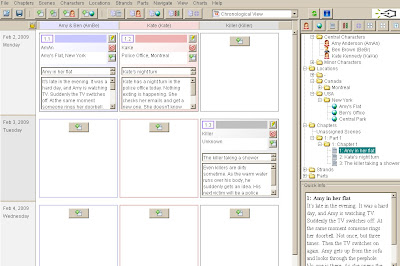
Well, Storybook does all that. You can create characters, locations, plot strands for each major character, assign a timeline, then just drag and drop your characters and locations into scenes, write scene dialogue and prose, assign scenes to chapters or acts...

It looks to be a very good, and free, tool for creating outlines and plot structures. It might also cut out those embarrassing errors when you've got the same character doing two things simultaneously a hundred miles apart...

But all this is saved in a proprietary format. So you'll need the application on all the other computers you use to be able to use it wherever you are.


So, if you want, try any of those, feel free. I do recommend them.

But I will still often resort to the most flexible, sophisticated method of all.

Brain, paper and pencil.

Next time - reviews - I'm going to start a series of them - new books and old classic books, alternating.

Till then - enjoy!

Monday, 22 March 2010

Back to the editing

Hi all.

After yet another enforced absence (pressure of work, feeble excuse, I know) I'm back, to continue the description of the editing process.

Last time (and it was, believe it or not about ten weeks ago,) we discussed the panel of readers, their feedback and how to put all the comments into a spreadsheet.

This time, I'm going to look at what we actually do with the spreadsheet.

In other words, how to actually edit.

So, In chapter 1, scene 1, we have reviewer A's comment:


The actual sentence was:

Tightly closed doors seemed to deny welcome or solace.

So that's easily changed, since I agree with the reviewer.

Tightly closed doors denied welcome or solace.

That's quite straight forward, isn't it?

But what about where reviewers say 'You need to add more action in the first ten chapters.'

How does one go about doing that?

Well, ahem, by adding more action and conflict and pace.

In this instance, I have to add to the plot.

I had a coherent plot, but, as with all books, the reality deviates from the plan by quite a margin. So, in order to change the plot and add bits, I have to know what's in the plot now, in terms of theme, motivation, character arc, sub-plots and so on.

That's best done by writing a treatment - in other words, re-analysing the book using the snowflake method.

Which I'll apply to this book and detail in my next post.

Until then, enjoy!

Sunday, 10 January 2010

I've been tagged

I've been tagged (who knew?) by two friends, Sonia Carriere and Anna Walls so I suppose I'd better answer the questions and then tag three more unfortunate bloggers :) Be sure to visit their blogs as well for a good read.

1. What's the last thing you wrote? What's the first thing you wrote that you still have?
The most recent thing I've finished is a science-fiction novel called 'Distress Call', which I partly wrote for NaNoWriMo and completed at a much more leisurely pace afterwards. I wrote a bunch of stories and novels back in the early 80s and got rid of them all. I only started writing again about 18 months ago, so the oldest thing I have is a screenplay called 'Death Search'.

2. Write poetry?
No, except rhyming doggerel and the occasional haiku.

3. Angsty poetry?

What's angst?

4. Favourite genre of writing?

Science fiction, horror, fantasy, action thrillers. Both to read and write.

5. Most annoying character you've ever created?
'Under Secretary Whitehead, who always reminded me of a surprisingly clever caricature - the toad in human guise.' A direct quote, and partly based on some people I have worked for.

6. Best plot you've ever created?

I think so far, it has to be 'Revival' - a horror/fantasy novel I'm currently editing.

7. Coolest plot twist you've ever created?
In a short story called 'The Return of the Creature'. Love conquers all, even between different species.

8. How often do you get writer's block?
Never. I always stop in the middle of a sentence or a paragraph, so I know what I intended to write when I start again the next day. Once I've written a few words, I'm up and running again. For me, delaying starting anything isn't block, it's inertia.

9. Write fan fiction?
No, though I did create an outline for a two part Doctor Who season finale. It turned out to be amazingly close to the actual season finale, including some of the lines of dialogue. Pure coincidence, as I intended mine for the following season, and I hadn't even submitted it.

10.Do you type or write by hand?
Type. I can't read my own handwriting half the time.

11. Do you save everything you write?
Yes. In several places, just in case.

12. Do you ever go back to an idea after you've abandoned it?
Sometimes I'll revive an idea that failed as e.g. a novella as a screenplay instead, or vice versa.

13. What's your favourite thing you've ever written?
I think that would have to be 'Halifa', but it's still waiting its turn to be edited.

14. What's everyone else's favourite story you've written?
Opinions vary, probably 'Revival'. So far.

15. Ever written romance or angsty teen?
No angsty teens - my characters are like me - old and past it! There are romantic elements in everything I write, 'cos it's a part of life.

16. What's your favourite setting for your characters?
Settings of extreme tension and fear. Where they're threatened by death and spattered with gore at frequent intervals.

17. How many writing projects are you working on now?
I'm editing one novel, and writing two short stories. Also developing ideas for the next bunch of stories/scripts/books.

18. Have you ever won an award for your writing?
Not yet.

19. What are your five favourite words?
"One ring to rule them." Oh, you mean in real life? "Your cheque's in the post."

20. What character have you created that is most like yourself?
Most of the male protagonists are like me to a certain extent. Or perhaps, like me as I'd like to be.

21. Where do you get your ideas for your characters?
Usually, people I know or have known. You know, mannerisms, habits of speaking, things like that. Physical appearance - sometimes, particularly in film scripts, I like to picture who would play the characters when Tarantino makes the film. So then, the character resembles the actor. The alien ones of course are just that - alien.

22. Do you ever write based on your dreams?
No. I do get a lot of ideas for stories when I'm in that happy state between waking and getting up, just quietly dozing, but usually what I dream about makes no sense, even if I wake myself up and write it down immediately.

23. Do you favour happy endings?
Only if they come naturally. Which is rare, since most of my stuff is quite dark and bleak.

24. Are you concerned with spelling and grammar as you write?
I will go back and check from time to time as I write,but a lot will be left untouched until the first sloppy proofread.

25. Does music help you write?
Once I start writing, I become oblivious to anything around me, so I wouldn't even know if music was playing.

26. Quote something you've written. Whatever pops in your head.
'Offbury was a typical English rural market town: pubs packed with young farm-worker types busy getting pissed; streets roamed by semi-feral, semi-naked packs of young girls emitting unbelievable decibel levels; corners and doorways littered with twelve year olds getting wrecked on white cider.'


From 'The Symbiont'.


My three victims tag choices are:


Jaimey Grant


Henry Lara


Gwen McIntyre

Enjoy!

What to do with critiques - part three

Alright, the moment is finally here! We've amassed our panel of readers, sent off the manuscript, and it's come back, spattered with red comments and notes.

So what do we do with it now?

Simple. We make a spreadsheet.

"What?" you cry in horrified disbelief. "Make a spreadsheet? I'm a writer, not an IT technician!"

Nonetheless - make a spreadsheet.

Consider: you have umpteen scenes in your book - one or more per chapter. In the example I'm using, there are twenty-seven chapters, and a total of one hundred scenes. When I'm rewriting the book, I can either open up my copy of a scene, then refer to what Fred said, and what Bert said, and Mary, and Ethel, and ...; or I can open up the spreadsheet and refer to that instead.


In the left-hand column, I have the chapter and scene number - e.g. Chapter 21, scene 3 (21-3). In the next columns I have what my reviewers (or critiquers if you prefer) said about that scene, one column per reader. I simply go through their critiques, cutting and pasting their comments about various bits into the appropriate cell.

A couple of technical terms here:

  • Their comments won't fit easily into a cell on a spreadsheet, so format all the comment cells as 'Text' and turn Word wrap on.
  • You can record a macro to format each cell as you enter content - so font size, orientation, alignment and so on are consistent - if you feel comfortable doing that.
  • Or simply wait until you've finished with each reviewer and format that column when you've come to the end of their critique.
  • Have a few rows at the end for their general comments.
Now, I can see at a glance what each of my readers said about each scene. It's very easy to find out if they said the same sort of thing, or if they differed, or if they had no comment about the scene at all.

As you can see from my example, at least in the section I chose, there was no general agreement. So I read each comment and decide whether, on considered reflection, I agree with it. If I do, I rewrite that scene accordingly. If I don't agree, I leave things unchanged.

Obviously, if all, or most of, the readers say the same sort of thing about a scene, it would be wise to change it, even if you may not agree with their comments.

Using a spreadsheet like this is much easier than going through each critique, constantly referring back and forth to the others and to the original.

By the way, at this point, I'd like to thank the readers who helped me on this book - Gwen, Renee, Wendy and Tj. Most of the improvements in the work are down to your keen eyes and good judgement. Any clunky bits left are entirely of my own making.

The general comments are also massively helpful. There was unanimous agreement that the first ten chapters were too slow. A deeper exploration of character was needed. Less tell, more show. More action. Helpfully, there was also a consensus that the work was too short. So I can add bits into those chapters without having to struggle with over-large word counts.

OK, it does mean practically rewriting those chapters from scratch, but I happen to agree with the comments. You cannot afford, any longer, to start slow and build. You have to start with a bang and get louder.

In the few next posts, I'm going to be dealing with the actual editing process.

Until the next time - enjoy!

Saturday, 2 January 2010

What to do with critiques - part two

So, as promised, here I am again, doing the soon-to-be-regarded-as-regular weekend blog.

Two per cent of the way through the year. Only another 49 topics to think of!

Last time, I discussed the composition of the panel of readers/critiquers to whom we send our beloved manuscripts.

Then, while waiting for the replies, we got on doing something else.

Replies start trickling in during the allotted time. Do we read them straight away, see what they have to say about our baby?

No, first we reply to the emails, thanking the respondents for their efforts and promising to get back to them when we've had a chance to digest their comments.

Well, yes, of course we read them. It's only natural to want to know immediately what people think about our work, isn't it?

But really, there's no reason why we should. We have, at least temporarily, abandoned that work and are fully committed to whatever we're doing right now. So, being wise, we create a new folder on our hard drive and put the attachments (Word documents doubtless covered in metaphorical red ink) in the folder, along with the original.

The deadline for replies draws near. We scan the inbox with increasing frequency (and desperation.) We asked ten people to read the work and only two have replied so far. What's going on?

Human nature, that's what.

You'll get another five or six replies in the last couple of days.

OK, we have all the replies we're going to get, so what next?

Scan through each of the revised manuscripts first, just to get a flavour for what the reviewers are saying. It's traditional to put closing comments at the end, so if you want to end the suspense quickly, skip to the end of each document and read what their overall take on the book was.

Take a moment to bask in a warm, fuzzy feeling of adulation. Alternatively, storm out of your writing room, kick the cat, pour yourself a stiff drink and give vent to your feelings about the reader's dubious ancestry, under-performing neurons and myopic inability to recognise talent if it got up and bit them on the ass. Perhaps even do both. You'll likely get a mixture of good, lukewarm and critical comments.

Well, what did you expect? You knew from the start that not everyone was going to like your sacrilegious, splatterpunk rewrite of The Red Shoes.

Didn't you?

Think again. No matter how good your writing, not everyone is going to like it. People's minds don't work the same. What, to some, is an exquisite heightening of tension is, to others, tedious and drawn-out. Your sparse, elegant prose may seem to some to be under-descriptive.

Never mind. The real work starts next. This is where we collate the responses in the easiest way I've so far discovered.

Next week...

See? Heightening the tension even more.

Till then, enjoy!

Thursday, 31 December 2009

What to do with critiques

First let me take the opportunity to wish all readers of this blog a very happy New Year, where you get all that you wish for. Sounds like an ancient Chinese curse, doesn't it? But you know what I mean.

Second, although the one New Year's resolution I kept, ever, was the one where I resolved not to make any more resolutions, I am making a solemn undertaking (not quite a resolve perhaps?) to post this blog every weekend during 2010.

Drat, that means I've got to think up something semi-interesting to say about 50 topics next year.

Now, on to business - the editing process.

Last time, I discussed sending out your finished first draft to a panel of readers. Remember, this is draft A-1, where you've already fixed the problems you became aware of during the writing of it, and done a quick proofread to fix obvious mistakes.

Today, let's think about who is going to be on your panel of readers.

First, they must be habitual readers. That might seem obvious, but choosing, for example, a brother-in-law to read it, when he doesn't generally read a novel from one year to the next, is useless. He has no background on which to base an opinion of a work of fiction. People who read a lot, on the other hand, know what works for them and what doesn't. There is also every chance they'll be able to offer an informed opinion on what needs to be changed to make it better.

Second, they should not be close friends or family. To use the brother-in-law example again, he might feel obliged to heap praise on it for familial reasons. (Alternatively, he might feel compelled to savage it because he can't stand you. Either is a likely outcome.) You want people who are either total strangers or cyber-buddies. I'm thinking here of sites like Goodreads and the Online Writing Workshops These people may be friendly towards you, but they are insulated by the electronic medium. They can be brutally honest. In fact, you should always ask for honesty in their critiques, just as you would give honesty when critiquing the work of others.

Third, it helps if they write themselves. Fellow writers can point out mistakes in the larger structure (the macroscopic elements) of your work. Holes in plot, faulty chronology, lack of pace, conflict,tension and so on are best picked up by writers who have made the same mistakes themselves. They are also more likely to correctly identify the microscopic errors - shifting POV, too much tell, not enough show, and all the other mistakes we (I) tend to make when churning out first drafts.

Fourth, they have to be willing to do it. Again seems obvious, doesn't it? If someone says 'I'll read it, but I'm so busy I can't do it till August' - that basically means that person cannot be of any use to you right now. They may really be too busy, or they may not want to do it. Either way, you are in no position to insist. Nor should you.

Fifth, balance in the composition of the panel (this is an ideal). Equal numbers of men and women, young and old, cynics and romantics, fat and thin, active versus sedentary, a mix of sexual orientations, dietary preferences and religious inclinations. Yeah, well, good luck with that. This is a blog about writing fiction, but even I'm not that far into the realms of fantasy.

How many should you have on your panel? You need enough so that you can have a majority opinion on improvements. So, more than two. Remember that if ten people promise to critique your work, only seven or eight will actually do it, at best. That's a fact of human nature. Other things crop up, disasters occur, and reading your stuff is going to be fairly low on their list of priorities. But do ask at least seven or eight to read your stuff.

Do set a time limit - politely of course. Can I please have it back six weeks from now at the latest?

How do you get readers in the first place? By doing the same for them, being brutally honest, praising whatever is possible to praise and sticking to agreed time limits. Reciprocity is the name of the game here. Reciprocate first :)

What do I want these readers to do exactly? Just what the name says. Read your book. Make suggestions for improving it e.g.

  • this scene doesn't work
  • this character serves no useful purpose
  • you need more action in the first quarter
  • the climax isn't big enough
  • character Y shows no development during the course of the book
  • you have a character in two different places at the same time
  • this fact is wrong
  • the dialogue isn't natural here
  • people in Venice don't do that
  • your POV shifts suddenly in these scenes
It would be nice if they added what they did like about the book. Most people will do this anyway. They feel uncomfortable about criticising (even complete strangers) and are happy to praise.

What you don't want them to do is painstakingly proofread the thing, getting subject-verb agreement, tense, syntax and flow right. After all, you're going to be rewriting large chunks of it after you've absorbed their opinions, so there would be no point, right?

So, as agreed by email, you send off your (ideally) Word document. I would send it off as a .doc (i.e. save as Word 97-2003). Not everyone has Office 2007 yet.

A Word document because you want them to be able to make comments and insert examples of what they mean. If you use Open Office or Star Office or similar, save as a Word document. PDFs are no good, because they aren't easy to change.

A Word document because you want them to use the 'Track Changes' feature.

What about readers stealing my ideas? Any ideas we have and write about, other people have also had and written about before. Others will get the idea and write about it in the future. While there are horror stories about copyright theft and plagiarism, they are, in my experience, vanishingly rare. So don't worry about it.

Having sent your baby off, start doing something else while you wait the month, two months, whatever time limit you agreed on, for the responses to arrive.

Next time (this weekend, honest!) I'll write about what we actually do with the critiques when they come back, using examples from the book I'm editing right now.

Till then...

Enjoy!

Monday, 7 December 2009

Editing and proofreading - 1

Hello again, Constant Reader!

Today and for the next few weeks, I'm going to be focusing on the various processes that go into producing a polished manuscript from a first draft.

First, I must make an admission. I am perfectly happy to talk about plot structure, theme, tone, pace, style, characterization, romance, action and the actual mechanics of producing a finished first draft (be it novel, story or screenplay). I even think that I have a fairly good idea of what I'm talking about. I produce finished first drafts that are, by all accounts, good.

Editing is different. It's a newish field for me. I've done some basic research and now I'm learning by doing, making it up as I go along. If you think what I write here is absolute rubbish, please tell me. You probably know more than I do about this.

Some definitions first:
  • Critique - the specific opinions of non-related readers about first draft A
  • Editing - the act of restructuring draft A, adding scenes, removing characters and so on, based on the critiques and your afterthoughts, to produce draft B.
  • Proofreading - the re-reading of draft B, with minute attention to detail, to remove extra spaces, typos, wrong words, POV shifts, clumsy sentences, wrongly named characters etc.
So, the difference, to me at least, between proofreading and editing is one of scale.

Editing means the big changes. Character X serves no useful purpose, and you want to get rid of him. You want to introduce Character Y, because she adds some sexual tension. You need three extra chapters from the antagonist's POV. The setting changes from Kansas in the summer to the Himalayas at mid-winter. Your protagonist is in fact from another planet.

Proofreading means catching all the rest, all the little faults that are so irritating when we read them in other people's work.

Step one then, logically, is to send out draft A to our willing panel of readers, to get their helpful critiques.

Or is it?

Not really. I've noticed that by the time I've finished a novel or screenplay, I already have second thoughts. I know I've certainly made mistakes in grammar, syntax, spelling, word choice, character names, chronology...

To me, it would seem rude to send out such an ill-moulded lump of clay to readers, willing or not. So I have an intermediate step. Fix the problems I already know are inherent in the work (let's call this the preliminary edit) and do a semi-thorough proofread before sending out the draft. We'll call this draft A-1.

Then send it off to the readers and get on with something else. When it comes back, begin assembling their opinions.

Which is what I'll pay more attention to in the next blog. The critiques and what to do with them.

Wednesday, 2 December 2009

Back after NaNoWriMo


Hi all, I'm back! After the unmitigated hell that was the National Novel Writing Month.

OK, I did the requisite 50,000 words and a bit more, so I was proclaimed a winner. However, the book isn't finished, and I actually wanted to do 100,000 words, so I only feel partially successful.

Back in July, I wrote 100K in a month, but I was on holiday from one job and one course then. It's not so easy to chisel out three or four hours a day when many of those days are twelve hour work days as well. Even forgoing wimpish things like food and sleep, it's not easy.

So although I made the 50K with a couple of days to spare, I'd already given up on the idea of 100K.

It was also difficult at times to find the motivation to do anything after a day's work and/or a teacher training course. Doing stuff before going to work might be considered an option: until you've heard my wife complain about being woken early, that is.

I still have about 10,000 words to go to finish the book, and in general I'm happy about the structure, shape, content, language, tone and pace. When done, I'm going to set it to one side and start producing second drafts from the three other completed books I have stacked up.

But that's editing, not writing. So I've developed the ideas for several short stories to keep my hand in while I'd doing the editing and patching and cutting and moving and rewriting and adding and subtracting...

And I'll have slightly more time for this blog as well. The next post will be about editing.

Friday, 30 October 2009

Plot: themes expanded

In this last blog before I start the NaNoWriMo (National Novel Writing Month if you didn't already know), I'm going to go slightly deeper into the topic of themes.

But first a digression. The aim of the NaNoWriMo is to write a fifty thousand word first draft of a novel in a month, the month being November. This is my first attempt. I've done the sister campaign, the April Script Frenzy, when you write an entire movie script in a month. I did a mock NaNo in July, when I wrote 100K words. So this time I'm aiming for 100K words as well.

To that end, I've been outlining the plot and detailing the characters using the snowflake method - see Randy Ingermanson's site for more details. Basically, you describe the story in one sentence. Then expand it to a 5 sentence paragraph. Then create character summary sheets. Then expand the plot to 5 paragraphs, create a one page character synopsis for each of the major characters and so on.

The idea behind all this is to ensure that come November 1st, everything is worked out, plot is known, each scene is sketched out and all I have to do is write around 4000 words a day.

So what's my story about (I hear you ask)? What's the theme?

By theme, I mean which essential human emotion is being most thoroughly explored. Which element of the human condition is being plumbed and exposed.

There aren't that many themes, just as there aren't many basic emotions. Perhaps the commonest ones, the heroic ones, together with some filmic examples are:

  • Vengeance - (Gladiator)
  • The reluctant hero (High Noon)
  • Overcoming inner demons (My Beautiful Mind)
  • The tragic hero (Troy)
  • The family protector (The River Wild)
  • The coward transformed (Deliverance)
  • The tortoise and the hare (Die Hard)
  • True love conquers all (Casablanca)
  • Doomed lovers (Romeo and Juliet)
Now, my story can be summed up in one sentence:

"Can two lovers persuade their opposing factions to fight the enemy in their midst?"

What theme is being explored here?

I mention lovers, so there's obviously a romantic element. I mention opposing factions, so there's obviously conflict. I mention an enemy so there's more conflict.

It's clear from that one sentence that the lovers are going to have to convince warring groups to co-operate, so Romeo and Juliet might spring to mind.

But there's personal tragedy a-plenty, for which vengeance must be sought. Neither of the lovers wants to be a leader or a hero, so they're reluctant. Each has his and her own inner turmoil to confront. The enemy at first seems unbeatable, so tortoise and hare. The only ones that aren't present in bucketfuls are the family protector and the coward transformed.

This is often the case. A novel's main plot may express one theme, but other themes are brought out in the sub-plots. One major character may represent one theme while another may have completely different motivations.

And so it is here. I would say that honour and duty are the predominant facets of both the major characters, so reluctantly, they do what must be done, no matter the cost to themselves or others.

In my next post, whenever that may be, I'll expand on the ideas of conflict and romance a little more, as they are two essential elements to nearly every fiction and every theme.

Sunday, 25 October 2009

7th Son: Descent by J C Hutchins


Just a quick reminder: I don't give 5 stars (well maybe once or twice a decade). I'm stingy. I'm mean.

So, on with the review.


7th Son: Descent by J. C. Hutchins

Now, I haven't read all of this book. I've only read the first 33 pages. So I can make no comments about the book's overall structure, or character arcs, or sub-plots.

What I can comment about is the quality of the writing.

It is superb.

From a real kick-ass opening, unexpected metaphors and unusual word formations flow with assurance. Characters are introduced with almost dizzying rapidity, yet each establishes his individuality, his own personality, rapidly and with great economy of prose.

The dialogue is believable, snappy; the internal thought processes consistent with the character thinking them. Vignettes of their various normal lives are pointed enough to let us get an idea of what they were like before something happens to them.

Something unexpected. Something horrifying.

The action sequences - and yes, there is plenty of action, from the prologue on - are well executed and realistic.

The basic premise of the book is excellent.

All I can say is that I'm going to order a copy this week - the print version comes out on the 27th - and if the rest is as good as the start, I'll write another review, this one going up, perhaps to that fabled 5 star realm where only the literary giants dwell.

OK, hyperbole, but this book is really very, very good.

So, Mr. Hutchins, or Chris if you prefer, excellent beginning. I was hooked from the first page.

I'm happy to give it 4 stars.

PS - I bear no relationship or affiliation with the author, and have not been offered any inducement of any nature to write this review, apart from a simple request that I do so. I don't know if it's a requirement to make that statement yet, but I thought I'd make it clear anyway.

Previews and the first episode of the book can be seen at

http://jchutchins.net/site/about-7th-son/7th-son-descent/

The book details are: ISBN 978- 0- 312- 38437- 1

and it is available to order online from:

Amazon
Barnes & Noble
Borders
Books-A-Million
Powell’s
Macmillan
Indiebound

Saturday, 17 October 2009

Review: 'Riders of the Spew' by Robert Thompson

Remember, I hardly ever expect to give 5 stars to anything. 1 star is so bad, I wouldn't even finish the book.

2 = OK, passes the time
3 = Good, would recommend and read again
4 = Very, very good.

'Riders of the Spew' by Robert Thompson (available from Smashwords and Amazon)


OK, where to begin with this one? Don't think I've read a book quite like it before. Robert Thompson fills nearly all his pages with action, action and more action. Occasionally interspersed with dry humour.

It would have been hard for me to imagine that I could have come to empathize with a collection of six sociopathic, sadistic killers and their savage, mutant steeds, but perhaps the book contains a kernel of hard truth. A few centuries in hell changes a person. And some of the creatures they encounter!

Well drawn characters, natural dialogue and a host of unexpected twists kept me reading 'Riders of the Spew' non-stop from start to finish. I look forward to the sequels - their work is not yet done. Well worth three stars.

Reviews: Spellbound by Jaimey Grant

My review system:

5 stars is only given to books that are brilliant; ones that I will want to read again and again, ones that will become classics. I haven't come across more than a double handful of those in my lifetime, and I read a lot.

4 stars is given to books that are very, very good.

3 stars goes to good books, that I enjoyed and which had few or minor slips.

2 stars means that it passed the time in the absence of anything better to do, but I wouldn't want to read it again.

1 star indicates that I was sorry I ever picked the thing up, and wouldn't want to recommend it to my worst enemy.

"Spellbound" by Jaimey Grant, ISBN: 1440414726


I read this recently.

Now I have to admit, the genre, Regency romance, is not something that I habitually read. Well, to be honest, it's not a genre I've ever read.

I have to say, I was pleasantly surprised. It was a lot better than I was expecting. The protagonist, Raven, was someone I took to immediately. There was an admirable supporting cast of eccentrics, Regency fops, nobility in various shades of good, evil and torment, and a good story line. It's not a genre I could relate to, but I was hooked and made to care about the ultimate fate of Raven. All the characters were believable and well-realized. There were sub-plots and red herrings in abundance, and the dialogue was often snappy, believable and witty. There were a number of words and phrases that were new to me, but that were authentic to the Regency period.

The book was also proofread and edited with very few mistakes that I noticed.

I have to admit I got confused at the late introduction of the nemesis, but overall, I thoroughly enjoyed it; much more than I was expecting.

So I am happy to award this a 3 star rating. Nice one, Jaimey.

Friday, 16 October 2009

Plot structure - expanded

This post focuses on the classic Aristotelian three act structure.

Broadly speaking, any work of fiction, whether a novel, novella, short story, play or film script, will fit into the three act structure. I'm going to generalise here, but the structure goes something like this.

Act one:
About one quarter of the length of the work. Starts off with the main characters going about their daily business. A little scene-setting, as it were.

A short way in (3-7 minutes for a film, somewhere in the first chapter for a novel) comes the

Inciting incident (also called the complication.)
This is the thing that forces the protagonist into motion. It doesn't even need to be in the work. It can have happened way back in the back story. In Lord of the Rings for example, you could argue that the inciting incident happened in the Hobbit, when Bilbo found the ring. Or a thousand years ago, when Gollum found it. Or three thousand years ago, when Isildur didn't destroy it. But generally, it happens in the work you're creating.

The II is the thing that propels (or perhaps compels) the protagonist to become involved in the action of the story, often reluctantly.

Also in Act one, all other significant characters are introduced, especially the nemesis. The threads of the main plot are laid. Some of the major sub-plots are introduced.

Act one ends with

Plot point one, a critical incident. Our hero(ine) discovers a crucial fact, gains a significant ally (buddy, rival, mentor or similar) or develops a talent he or she will need to defeat the nemesis.

All the significant features of the story have now been exposed to the audience. From this point on, all that occurs is inevitable because of the groundwork you have done.

Act two:
This is where the majority of the character development, the other sub-plots and a lot of the action takes place. Generally about half the length of the work. If Act one was about laying the foundations, Act two is about building the house. About halfway through this act comes the

Midpoint. This is the first significant trial of strength against the nemesis. Our hero may retire, defeated but alive. He may defeat the chief lieutenant of the enemy. The point is, it is inconclusive. The threat remains, and from here on to the end, intensifies.

Act two concludes with

Plot point two (also called the Crisis.) Our protagonist is at his lowest ebb. His wife has been kidnapped, his dog shot, his son proves to be the spawn of the Devil, and he's hanging head down over a vat of boiling sulphuric acid.

This point is perhaps the most important of the whole story. This is why our protagonist is a hero. Remember the classic themes mentioned in the last post.

Now, any reasonable being would give up at this point. Heroes don't. They're too stubborn, or stupid, to recognise that they're beaten. Instead of dying quietly, they get mad. They stiffen themselves for one final attempt.

They take full responsibility for their life and their actions, taking charge of events. If they have been reacting so far, now, in a titanic expenditure of will and courage, they take charge of events, driving on to the end. Their entire life has narrowed down to one focus; victory or death.

Act three:
This occupies the final quarter of the work. If Act one was laying the foundations, and Act two was building the house, then Act three is defeating the neighbour who objects on planning grounds, stopping a horde of crazed bikers from trashing the place, throwing up a wall of dirt to stop the flood from washing the house away and finally moving in with your loved one.

Almost immediately, we are plunged into the

Climax. The final trial of strength. Our hero generally overcomes his fears, his limitations, masters that crucial flaw and defeats his nemesis, who cannot do the same.

OK, our hero may die in the process. In many ways, it is deeply satsfying if he does. After all, who would actually want to know or live with a genuine hero? They can't be easy people to get along with.

Of course, if you're writing from the 1st person POV, it is not a good idea to have your hero die here. That's the end, fini, right there. If you've used third person, shifting POV, fine. Film scripts, you have written omnisciently anyway, so no problem.

The climax was presaged in Act one, developed in Act two, and is now fully realized in all its violent, terrible beauty.

Act three finishes with the

Resolution. All the loose ends are tied up. Unless you want to leave room for a sequel. Boy gets girl, music swells, they walk hand-in-hand into a beautiful sunset. The audience sighs in appreciation, gets gently returned to reality and walks out happy, having shared time with someone who took charge of their destiny, albeit briefly.

Something most of us can never, will never do.

That's why they're called heroes.

Monday, 28 September 2009

Plot - theme or structure?

First, yet another apology. It seems that whenever I'm presumptuous enough to post that I'm going to write about something 'tomorrow', fate intervenes, and I get buried in extra work. Yet again it's taken me three weeks to dig myself out far enough to see daylight. In future, I'm going to simply say 'next time I'm going to...'.

So, not tomorrow, but three weeks later...

There are two ways of creating a plot - with almost any sort of story.

You can focus on the structure - that is, what happens in the story?

Or you can focus on the theme - what is the story about?

As a concrete example, consider the clasic Western 'High Noon'.

Structurally it's about a man who is systematically abandoned by all those on whose loyalty he has a right to depend, prior to his impending battle with a band of vengeful killers.

Thematically it's about a man's struggle to maintain his integrity and honour when surrounded by cowardice, hypocrisy and overwhelming temptation. He is an archetypal reluctant hero.

I suppose you can say that structure focuses on the events; theme focuses on how the participants feel about those events; or perhaps the actions they choose when faced with those events.

Now, you might say that the two are very much interdependent. You'd be absolutely right. A person can't be a hero, reluctant or otherwise, unless there is an occasion where heroism is called for.

There are only a limited number of themes available - such as:

  • Vengeance - (Gladiator)
  • The reluctant hero (High Noon)
  • Overcoming inner demons (My Beautiful Mind)
  • The tragic hero (Troy)
  • The family protector (The River Wild)
  • The coward transformed (Deliverance)
  • The tortoise and the hare (Die Hard)
When designing a story thematically, I suppose you would have to start by creating a protagonist with a flaw, and an antagonist, also with a flaw.

You can already tell that this story would be about the protagonist being able to accept help and advice, overcome his weakness and so defeat the antagonist - who of course, because of hubris was not able to overcome his, and so failed.

Structurally, you would start with an exciting idea - a protagonist who has a mortal falling out with his former best friend. They fight on a high, swaying bridge above a bottomless pit.

Synthesis of the two gives you the protagonist afraid of heights, who falls in love with his beautiful psychoanalyst and rescues her from his former best friend turned nemesis. She is of course at the far end of the bridge on which the two are fighting. The nemesis was in love with her till she fell for our hero. He spurned her offer of help overcoming his fear of hamsters.

At the height of the battle, our hero presses forward despite his profound acrophobia to rescue the woman he loves. He hurls his pet hamster at his nemesis, who recoils in horror, slips and plunges to his death. Boy and girl reunite, hero risks all to rescue beloved hamster from the lip of the abyss, and hand in hand in paw they walk into the sunset as the music swells...

OK, it's a silly example, but it illustrates my point. Theme and structure are different ways of looking at the same small, isolated sequence of events that makes up a piece of fiction. Both are still, and always will be, subordinate to the story.

Avoiding hubris myself, I'm simply going to say that next time, I'm going to examine plot structure in more detail.

Till then, enjoy!